Monday, July 29, 2013

Quarries on Tatooine

On Tuesday, our last day with Danny, we drove from the Dead Sea to Jerusalem, stopping at a few last historical sites on the way.  Much of our drive was through the Negev desert, a particularly dry region with large changes in altitude that Josh thought looked like Tatooine.
Our first stop was at a Tel Maresha's Caves.  In this area, there is a thick upper crust of rocky soil called the "nari", with chalky, crumbly soft stone beneath.  This made it easy to carve cisterns, using the natural structural integrity of the nari as a roof and the easily carved chalky rock as a quarry.  These rocky passageways and manmade caves have a great acoustic and provided a welcome respite from the blazing sun.  The temperature drop was incredible; this is definitely where I would have hung out back in the day.  My mom agreed, going so far as to say she was probably a quarry manager in another life.  We also got to see the giant underground dovecotes of the Columbarium Cave; doves were used for food, as messengers, for cult purposes, and for their manure (a useful fertilizer in a desert).
In the area of the caves was also a karob tree; its dense and fibrous pod tasted wonderfully sweet when chewed.  It turns out that the karob "chocolate" treats that I used to steal from my dog (sad as that is to admit) are made from the sugar of this plant's husk.  As another fun piece of trivia, the karob seed is thought to be the original measure for karats of diamonds - one seed weighed one karat.

Our cave exploration continued at several other sites, including at the Bell Caves of Bet Gurin-Maresha Park.  These caves were quite large and hosted both a large family of bats and some ancient carvings of both crosses (from the Crusaders) and the name of Allah in Arabic.  Our other stop during the drive was Ephesus Dammim, between Socoh and Azekah - for those who are Biblically illiterate, like me, that's where David killed Goliath.  I never realized before that Goliath was supposed to be nine feet tall.  My childhood imagination had always made him about 50 feet tall.  The story also includes a lot of bad mouthing of David by his brothers and other fluff.  The things you learn from dramatic Bible readings, right?

At long last, we arrived in Jerusalem.  Due to the ever-present traffic, we had plenty of time to admire the various public buildings, from the Knesset (the Israeli parliament building) to the elaborate YMCA (designed by the same guy that did the Empire State Building) to the tiered graves on the Mount of Olives.  Jerusalem is a gleaming city, with every building built of or faced with Jerusalem stone (locally quarried limestone).  This was the style of building in ages past, and it is now law, so the architecture of past and present meld almost seamlessly.  That said, the current city has far outgrown its old boundaries (a tall wall). While the old, walled city is about a square mile, the current area of Jerusalem is at least nice times that size (a rough estimate from looking at a map) and boasts a population of one million people.

Given the amount of history beneath our feet, we counted ourselves lucky to have five days to immerse ourselves in all that is, and was, Jerusalem.

Spotted: Bedouin settlements.  Some are legal, some are illegal (and unrecognized).  Those that are illegal often use windmills and solar energy to generate electricity independently and stay off the Israeli grid.  Who knew rebels were so green?

Tuesday, July 23, 2013

Sinkholes and Salt

We started the day by diving straight into history, stopping at the Roman ruins at Bet She'an.  This city has only been partially excavated, since there is a modern community built over it.  This city was one of the decapolis cities, the ten cities built in full Roman grandeur to attract people to their way of life.  Each of these cities was built on exactly the same design, so that a Roman soldier entering any of them would already know his way around (including to the brothel).  At Bet She-an, only the public buildings were excavated, while the community housing has remained underground.

First, we wandered the gladiator theater.  The various entrances were different sizes, we can only assume because of the various entrants: the smaller shorter ones appeared to be for wild animals while the tall and skinny ones were for their human opponents.
A short drive away, we wandered the other excavated part of the city.  There, the various layers of city built atop city were revealed.  The majority of the revealed architecture was Roman: the grand colonnade, the dry and steam saunas, the theaters, and various other buildings.  The grand columns reached skyward, though a few were left toppled to show the way that they were found.  
Roman columns may be strong, but they were no match for the earthquakes that routinely shake this region.  At one place, the three layers of mosaic floors were revealed: Roman, Byzantine, and Muslim art tiered by century.  For an aerial view, Josh and I also hiked to the top of the hill, surveying the city layout.  Atop the hill were also a recreated Egyptian structure and others - further evidence of the recycling of cities and locations.

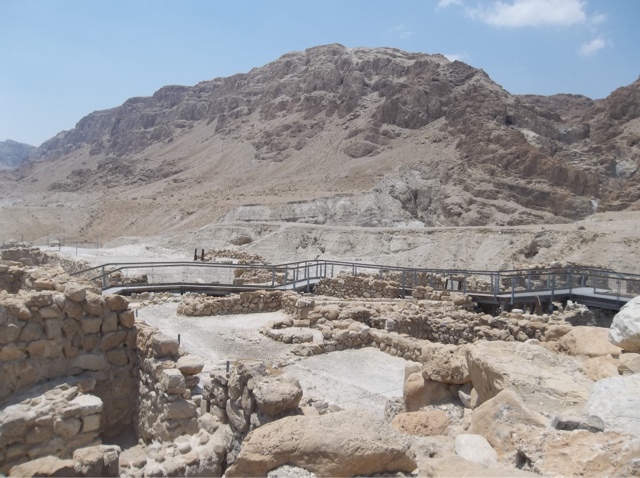
Next we stopped at Qumran, the site where the original Dead Sea Scrolls were found.  They were discovered in 1947 by members of a Bedouin tribe who threw a rock down into a cave while herding goats and heard the smash of pottery breaking.  They climbed down inside and found carefully wound leather scrolls with ancient Hebrew writing, stored in clay pots.  It wasn't until the scrolls had changed hands several times that their true value was realized: they were decoded and revealed as ancient Hebrew texts outlining the lives and rules of the Essenes.  This peaceful sect spent their days waiting for the End of Days and shared everything communally.  Every routine act had an associated ritual.  And all of this was written down on the Dead Sea Scrolls that have been found in the last half century.

Nearby where these scrolls were found (they have since been moved to the Israel Museum in Jerusalem), an excavation uncovered a building complex with rooms for the scribes, for communal eating, and for the other daily activities.  
Many artifacts were found here, from communal bowls to inkwells.  We wandered the site, appreciating the harsh beauty of the desert and the courage of populations that make their home here.  It was here that we also got our first glimpse of the Dead Sea, the water a gorgeous green-blue.  The sea was edged in white where salt crystals had grown along the shore.  I couldn't wait to swim in it.

We finished the afternoon with a hike at Ein Gedi, a park with several pools and waterfalls where locals go for a dip to cool off in the hot summer heat.  
Due to falling rocks, swimming is not prohibited in certain areas.  Danny told us that the ibex have learned to kick rocks at people, too.
Driving certain places is also off-limits, due to sinkholes that form.  But we made it safely to Ein Bokek on the Dead Sea, in time to watch the sun set over the chalky yellow mountains and the aquamarine waters.

Spotted: Hitchhikers.  Hitchhiking used to be popular among members of the Israeli army, young students trying to travel or get home.  Since several soldiers were kidnapped by terrorists this way, the army has forbidden hitchhiking by its members and the practice has generally declined.  But the other interesting tweak?  Hitchhikers don't ask for a ride by sticking out a thumb.  Instead they stick out a pointer finger, horizontally, as if pointing at the car they're hoping will give them a ride.

Float On

In the morning, my parents drove to Masada and took a cable car up the mountain to the ancient fortress.  Built by Herod the Great, this fortress overlooks the Negev desert and the Dead Sea and is one of a series of fortresses that Herod built a day's journey from each other (I believe there were seven in total).  Masada's real claim to fame, however, has nothing to do with Herod.  About a hundred years after Herod built the place, the abandoned fortress was taken by a group of Jewish fighters, the Zealots, who opposed the Roman forces swarming the region.  The Romans had already taken Jerusalem, and those who had fled had set up refugee villages in caves, fortresses, or wherever they could.  After all other rebel groups had fallen, wiped out by the ceaseless onslaught of thousands of Roman soldiers, Masada alone held strong.  The Roman army could not scale either of the thin, steep, winding paths up to the fortress in large numbers; spreading their forces into thin lines would eliminate the advantage of their large numbers.  As a result, the Romans literally moved mountains (of dirt) and built a giant ramp up to the fortress, with a tower at the very end.  This allowed them to use a battering ram and catapult, and fire flaming arrows down on the stronghold.  When at last they breached the wall, late one evening, the Romans withdrew to gather their forces.  That night, the Zealots decided that they would rather die at their own hands than surrender to the brutal Roman forces who would kill them anyway. The Romans would tell their enemies to surrender so that they might live, but they invariably killed them and made them slaves.  The Zealots also burned all of their belongings, so that the Romans could not plunder they village for their own gain.

How do we know this?  A few of the Zealots managed to survive.  We do not know how, but they told their story to Josephus Flavius and it has lived on until today.  This story has represented the courage of the Jewish people, their defiance, and (in an odd way) their ability to survive.  It was a story that gave the Palmach courage when they sought to fight their first opponents; Palmach troops would hike cross country to Masada to climb to the fortress and realize that they were the first Jewish fighters in that place in nearly two thousand years.

The afternoon was spent relaxing and enjoying the Dead Sea.  I was particularly excited, because this would be the first time I had ever floated in water.  After years of swim lessons, swim teams, and my own pool experimentation, I had never been able to float.  But with such a high salt content, the water of the Dead Sea was so dense that I would have to float this time.  And I did!  The water was like a bath because it was so shallow and the sun was so bright.  The ground was like a gravel of salt crystals.  The metal ramp leading into the water was crusted with salt.  Any small cuts burned in the salty water.  But once you get a bit further out, the water a few feet beneath the surface is cooler and you can float in a standing position with your feet not touching the bottom.  Or on your back.  Or any which way.  We had a blast, though we were diligent about not getting our faces in the water.

When we returned to shore, we enjoyed the other half of the Dead Sea experience: Dead Sea mud.  We had purchased a few kilograms of it and lathered ourselves up with the nearly-black mud.  Due to the high mineral content of the water and mud, it's supposed to be very good for your skin.  You smooth it on, bake yourself dry, and then go and wash it off.  
Sure enough, our skin came out baby smooth.  But the fun part was standing there like a human art project as we lathered each other up.

Spotted: Israeli hotel gyms.  They are small, if they exist at all, even in the larger hotels.  And they have limited hours, because they are always staffed.  In the US, you often just swipe in to the gyms and there is no attendant, but here they are required to have a staffer for liability reasons.  At the Isrotel, where we were staying, this attendant was a personal trainer who would come and correct your form if you were doing a move incorrectly.

Off-Roading

We spent Saturday in the Golan.  This disputed territory sticks up like a small northern lump off the main body of Israel, ooching its way between Lebanon and Syria.  Upon reaching the Golan, we exchanged our comfy car for an open-air Jeep and sped off.  
We wove our way through a kibbutz, admiring the blooming plants heavy with plums, pomegranates, dates, and various citrus fruits.  Smaller greenery was identified as cotton or peanut plants.  Our guide had grown up on the kibbutz but had moved off of it years ago to a nearby development.  He was still good friends with the kibbutz owners, though, so he felt comfortable stopping and feeding us fresh fruit from the trees.  The black diamond plums that we tried have probably ruined us for all other plums, forever.

After turning off the kibbutz, we drove along a highway that has formed the 1948 border of Israel, back when Syria glared down from the neighboring hill.  We then turned and drove up this hill, now a national park.  Beside the reclaimed farm areas (Israel has done a pretty incredible job of reclaiming land), the area was very dry.  We rumbled up the rocky path, the car rocking up and down and the nearby shrubbery and trees rubbing up against the sides of the Jeep.  
Ibex stood proudly and silently on the hill, melting into the colors of the hill.  We stopped to pick fresh figs, biting into the sweet fruit.  The fresh fruit is so different from the dried versions that you find in the U.S.  We continued our bumpy journey through the national park, eyeing the rubble of former Syrian army bases, the signs that warned of landlines off the path, the cows that are used to graze away the grass to create barren areas so that forest fires cannot spread.  Near the ridge line, we stopped to spread out a blanket, share a watermelon, and hear the history of the area and see the maps. 
 We learned about the struggle over water that had shaped these borders; water security is a recurring issue in this part of the world, with a greater urgency than in a place like the United States.

In that vein, we ended our Jeep excursion with a dip in the Stream of the Fig, wandering a watery path that cooled our feet.  The cold was jarring after the sun's heat, but felt so good.  Locals scampered through the water, similarly reveling in the cool relief.  It was nice to see the place where locals went to relax on the weekend.

Drawn to water as we were, our next stop was kayaking down one of the streams that feeds the Jordan River.  It moved quite quickly, making it easy to float down with minimal effort. The only paddling truly required was to turn your boat or thread your way through the other groups that splashed each other and generally blocked the way.  The river was full of inflatable rafts and kayaks and laughter.  The water swished in and out of the holes along the bottom of the kayaks, keeping us cool.  The promised "rapids" were about four feet long and had the similar bump-bump feel of riding an elephant just above its shoulders.

In the afternoon, we stopped at Kursi, where Jesus cast out the demons from a man and sent them into the pigs, which ran into the Sea of Galilee and drowned.  
We also stopped at a commercial baptismal site, which isn't actually where John the Baptist baptized Jesus, but the owners want you to think that it's close enough.  
The actual site is further upstream, in a less friendly area.  It was interesting to wander around, seeing the giant plaques where preachers from different nations and languages offered their version of the relevant scripture verse describing baptism.  
Definitely my favorite.
There were photos of Christian "celebrities" (many American, like Mike Huckabee), who had been baptized here.  You buy a flowing white robe with a rather cheesy image screen-printed on the chest, submerge yourself, and - voila - a fresh new Christian is (re)born.

Spotted: Thai labor.  Due to the extreme heat and heavy farm labor, many Thai workers are imported to work on the farms.  Due to the obsession with pale skin in that part of the world, they cover themselves completely while working in the sun.  Danny said that they are the only people willing to work in the greenhouses when it is 110 degrees in there.


Sewer Rat

We started our day in Akko, at the Hospitaller Compound.  There, we saw Crusader buildings that were later covered with dirt by the Ottomans and they built a palace.  This palace was then used as a prison by the British during the mandate.  Finally, it became a museum.  When one of the floors caved in during the night to reveal the courtyard of the Crusader complex below, archaeological excavations began in earnest.  
The building beneath is quite elaborate, with a large mess hall, courtyards and walkways, and flour de lis carvings to indicate that these were French Crusaders.  My favorite part was, interestingly enough, walking through the sewer.  It's now empty, of course.  The Crusaders emptied it when they felt threatened by the approaching Muslim army and they used it as a series of secret passageways through which they could escape to the port.  The site also has Mamluk architecture, a series of alternating red and cram bands and fluted arches.  
The Mamluk were Mongols who were kidnapped as children and brought to Egypt as a mercenary army.  Eventually, they became more powerful than their masters.

As we walked out, we saw a series of shops where the site had attempted to create a traditional bazaar.  Since it was Friday and most of the merchants are Muslim, nearly all the shops were closed.  In the two open ones we saw wonderful local crafts: in the first, a man with a hammer and chisel working intricate designs into a copper platter, 
while in the second a woman showed us jewelry made of old Roman glass and a series of funny t-shirts.

After so many manmade structures, we stopped at the Rosh Hanikra Grotto (or Ladder of Tyre) to appreciate the natural beauty of our surroundings.  
Carved out of limestone and flint, these caves form a beautiful underground pathway.  
It also gave us a chance to see the the border with Lebanon across a bit of the Mediterranean.  The division is marked with innocently bobbing buoys, and a battle ship stands ready to defend it.

As we continued on our way to Tiberias and the Sea of Galilee, we stopped at Tzfat to see the synagogues before they closed for Shabbat preparations.  Among those that we visited were those of Joseph Caro and Rabbi Isaac Luria.  
These are some of the original places where (Lurian) 
Kaballah teachings originated.  Despite the hype about Kaballah due to Hollywood celebrities, many of the teachings of Kaballah have been incorporated into mainstream Judaism for a very long time.
Down below are the grave sites of one famous rabbis.  They are considered holier dead than alive because now they are with God and can more readily whisper in his ear.

Next, we made our way toward the Sea of Galilee.  On the way, we stopped at the Mount of the Beatitudes, where Jesus gave the sermon of the mount and fed the 5,000. 
From there, we got our first glimpse of the Sea of Galilee, the site of so many stories.  Heck, that's where Jesus walked on water!  You would think he'd have picked the Dead Sea given the buoyancy, but Jesus never really made things easy for himself.
The Sea of Galilee is not what I expected at all.  First of all, it's not a sea.  It's freshwater and you can see all of the edges at once.  It's not nearly as big as the large lakes of the U.S.  On the longest side, the length is only about 18 kilometers.  In the words of Josh: "18K? That's an average crew workout!"

Spotted: kosher cellphones.  You get half-price minutes and it automatically shuts off during the Sabbath.  Only in Israel, folks.

Oh Danny Boy

Starting on Thursday, we traveled with our rugged guide, Danny.  His father's family came to this land in the 1870s, while his mother's family arrived in the 1930s.  He has lived in Israel his whole life (beside his travels) and has been a guide for the last 42 years.  He can talk on any subject that you bring up, from foods full of antioxidants to the transition of land between Israeli and neighboring governments.  He's the type of guy who can honestly recommend places and say "tell them Danny sent you", and they know who we are talking about.

As we pulled out of our hotel parking lot and left Tel Aviv behind, Israeli history swallowed us up through Danny's lessons and stories.  First stop: Caesaria, one of Herod the Great's many palaces.  
We found out that Israeli rock stars know they have made it when they play a concert in the ancient, reconstructed theater of Caesaria.  This amazing city, unearthed under the watchful eye of Israeli benefactor Baron Rothschild, is a tourist attraction and something of a resort town.  If it was good enough for the kings of ancient times, it's good enough for modern day vacationers.  The city must have been magnificent.  A giant pool house overlooking the water, a temple on the highest point dedicated to Caesar, a horse-racing stadium that could seat 10,000 butting up against the palace.  Other civilizations took over the city, including the Crusaders. Yet each time the city fell, leaving layer upon layer of ruins.  
It was here that I learned there were quite a few Herods back in the day.  And that Herod the Great, the one that I had always learned about, was a pretty shrewd guy even if he was also cruel.  Though it doesn't justify his actions, his cruelty was par for the course as kings went in that era. Killing your wife, sons, and mother-in-law wasn't as rare as you might hope.

Fun fact: to build the water break offshore, giant, hollow wooden structures were built, then filled with volcanic ash.  When these structures were placed in the sea water, the ash and water mixed to form a natural cement.  Brilliant.
Fun fact 2: Many words came from the roman theaters.  The word "scene" comes from the painted backdrops of these theaters, the scaena.
Fun fact 3: The outer room of the theater was called the vomitorium.  I had always heard this word in reference to the rooms where Romans went to vomit up food so that they could eat still more, but here it refers to the way that the building seemed to vomit people as the crowds exited.
Fun fact 4: The Roman aqueduct that brought water to Caesaria from the Carmel mountains (using only gravity) was built with a decline of less than one degree along its entire length of nine miles.

Next, we stopped at Atlit, a town best known for the Atlit Detainee Camp.  
The camp was built by the British Mandate for Palestine in the 1930s as a place for Jewish immigrants who attempt to enter illegally.  This was a particular issue during and immediately after the Second World War, when thousands and thousands of former concentration camp prisoners had no home to which they could return.  The Palmach (see yesterday's post) refitted old boats to carry these people, crammed in, on the 3-10 day voyage to what is now Israel.  Over 140 boats attempted to enter, but a British blockade enforced the immigration limits, and the people were sent to Atlit or later to Cyprus.  The Palmach was furious and broke into this camp, freeing over 200 prisoners in a single night.  Sadly, they also bombed ships meant to deport immigrants and once killed over 200 of them as they miscalculated their explosives and the Patria sank too quickly.  Other times, the immigrants died before reaching the British Mandate either in the skirmishes with the blockade or because the boats were simply too old, and sank.  The saddest part of this whole incident is the trauma to the prisoners, who had been torn from their homeland, put into concentration camps, then into refugee camps, then into a cramped boat, and then into a detainee camp with the same barbed wire and guards (albeit without forced labor, starvation, or gas chambers) as before.  
The creepy part?  They host a kids summer camp there.

That afternoon, we drove past the kibbutz of Ben Oren (where the Palmach-freed detainees fled) and through a Druze village, where women passed us in the traditional black robe and white head scarf.  An offshoot of Shi'ite Islam, the Druze are quite separate.  Interestingly, they believe that there is a fixed number of Druze souls.  I guess they will never be missionaries.

For our late lunch, we stopped for falafel.  Since Danny knew the owners and the day's rush was over, we got a huge spread and got to learn how to make falafel!  
As soon as I scooped the chickpeas up to mold them, I realized how much I have missed cooking these last few months.  It was fun to lend a hand.  As we molded the balls, Danny told us that falafel was actually an Egyptian invention, but they made them with Fava beans.  Since many Iraqis had trouble digesting the Fava beans, though, people eventually switched to chickpeas.

Continuing on our way, we stopped at a monastery on Mt. Carmel, thought to be the place where Elijah challenged the prophets of Baal.  As would become a trend, we forced Josh to do a dramatic reading of the appropriate Bible verse. 
From the peak - the highest in the region - we could see Nazareth, Armageddon, Mt. Tabor, Mt. Moret, Mt. Gilboa, and numerous other Biblical locales.
We ended the day in Haifa, stopping on our way into the city to admire the incredible Baha'i gardens.  The gardens are gorgeous, sloping down from practically the peak to Ben Gurion Avenue that leads through the German Quarter to the water.
Then, exhausted from the heat, we enjoyed dinner in the warmth of the evening at Fattoush, a restaurant that preaches Baha'i ideals of unity and equality.

Spotted: You can get kosher McDonalds in Israel!  Especially in Jerusalem.  Also in Jerusalem, most hotels (even the really nice ones!) charge for wifi, so get your kosher food fix along with your free wifi.


Thursday, July 18, 2013

The Hand that Feeds You

Our second day in Israel, we set out to get a taste of history and better understand this country in which we had landed.  To that end, we set out for Independence Hall, to begin with the beginning.  We wound through the streets of our "hip", graffitied neighborhood, trying to find this nearby monument.  We passed graffiti of a woman wearing a burqa and a shop selling t-shirts saying "We don't need another hero", among various shops selling cheap goods and cheap clothing.  Finally, after asking directions several times, we found Independence Hall.  It was a humble tan building with a little stone fountain in the middle of the facing street to make it look a little bit more important.  Two men slouched on the steps as a woman scrubbed the unoccupied spaces.  Dark glass obscured the inside and made it look rather deserted.  
As soon as we opened the door, though, we saw a large group of people seated and at attention in a room past the foyer.  We has missed an introductory video but had made it just in time for the English tour.  Well, you just sit in one room as  guide speaks at you, but it was a tour of Israel's history none the less.  
As soon as we were seated, the guide began, welcoming the two groups of students: the Americans and Canadians on one side of the room, and... the Germans on the other.  I guess we sat on the wrong side.  Our guide, a charismatic guy in his early twenties who used the world "miracle" for everything related to Judaism or Israel and claimed that the declaration of Israeli independence in this room "wrote a new chapter of the Bible", drew scoffs from the students around us and made me look up in surprise.  It was such a formulaic script, interjected with a little personality.  The exposed biases, the blind faith in his recitation of history... It felt like I was back in Vietnam again, choking down government propaganda.  My family tried to temper my skepticism a bit, suggesting that perhaps things had been amped up a bit for the students on their birthright trips, but I just disliked hearing such a one-sided presentation of history.  It was interesting, though, that they performed the ceremony in just thirty minutes in a bomb shelter (according to our guide).

Our second stop of the day was further north in Tel Aviv at the Palmach Museum.  
The Palmach, a predecessor to the current IDF in Israel, was comprised of groups of young Israelis eager to train and fight for Zionism and the promise of a Jewish state.  It was here that we got our first modern Israeli interactive museum experience.  Israel seems determined to make its history incredibly personal and alive to the museum-goer, using exhibits that do not display memorabilia or written descriptions on walls.  Instead, they use videos, a lot of sound effects, smoke and mist, and group experiences.  And you are required to be guided on your tour.  At the Palmach museum, you must sign up in advance and join a Palmach troop as they meet, train, cross the country on a secret hike, go on secret missions during the war, defy the British, lose loved ones, and offer yourself as "the silver platter on which the state of Israel was offered".  While I think that the interactive museum idea is an interesting one, the required groups and very specific path forced everyone to have the same experience.  There was no independence in the experience, the creation of understanding.  The pace was predetermined, and we shuffled from room to room like historically-inclined sheep.  While the videos are engaging, it is a bit disconcerting to have recreations (always with an element of fiction where the records have holes) as the only form of information offered, instead of a variety of sources.  Still, the museum was quite interesting and the Palmach members were courageous and incredibly dedicated to the Zionist movement and the creation and defense of Israel.  They were also quite clever.  When the Nazis made a push into northern Africa and toward Israel, the British asked for Palmach assistance on this new front.  But when the Germans were pushed back, the British no longer needed or wanted Palmach assistance.  The Palmach created a system where they worked half the month on kibbutzim and the other half training, thus covering their costs while advancing their military experience.  When the state of Israel was declared, the Palmach was folded into the IDF, a successful army by any standard.

After that historical perspective, we wanted a taste of modern Israel.  We hopped on a busy bus headed downtown and got off to wander through the Carmel Market and buy falafel from a street side restaurant.  
It was fun to watch the small storefront serve such a ravenous lunch crowd.  The small wire bin was constantly submerged in the hot, spitting oil as fresh falafel balls were fried into crunchy submission.  A salad bar of toppings - pickled cabbage, diced cucumber and tomato, cucumbers, peppery pickles, a variety of tahini flavors, tabbouleh, and others - was available for the customers.  We scraped the French fries off the top of our falafel and stuffed our pita with the fixings.  Delicious.  The Carmel Market was less exciting.  It was a market like any other market, but with few unique offerings.  The highlight was definitely the food stands.  We loved the stands that boasted every type of dried fruit - I loved the figs and dates - and the myriad types of baklava were overwhelming.  Honey oozed over cookie sheet-like platters.  We bought a few and apparently didn't reach the minimum weight, so our seller threw in a few more for good measure.  Heaven.  We also saw Israeli bagels, freshly made!
That evening, we wandered Old Jaffa.  Old Jaffa was the oldest continuously working port in the world until 1967, when the modern port of Tel Aviv was built a mere 5 km away and overwhelmed it.  The ancient village has had many incarnations, with layers of history literally piling atop one another - Byzantine, Roman, Ottoman, Muslim, Christian, Jewish.  We loved walking around the port, seeing the house of Simon the Tanner where "St. Pete" (the signal was rather informal) raised Tabitha from the dead and had visions that Christians should be baptized as Christians and could eat food previously forbidden by kosher laws.  
We saw the old lighthouse, the old Greek Orthodox Church, and numerous art galleries (Jaffa has been reborn as an artists' colony).  We went on a tour of the underground archaeological site beneath Kedumim Square, seeing relics from the various centuries (arrowheads, perfume bottles, coins) and enjoying more interactive videos.  
These were used to stop charging horses the way the modern equivalent is used to stop a car.
Our guide was irreverent and hilarious, discussing the serious pollution problem from people smoking too much opium, the attempted assassination of Napoleon (they are very proud of his visit), and so on.

Finally, we ended the evening with a fascinating dinner at the Blackout Restaurant.  
We had wanted to go to the theater performance by the blind-deaf actor group, but they were sold out.  So we dined in... Darkness.  Our waitress, Galina, led us to our seats around a table, described the location of our silver wear, glasses, and water jug, and advised us gently as to how to survive a dinner in the dark without spilling something all over ourselves.  We dined on salads, fish, gnocchi, a dessert sampler, fruit salad, and bread with a delicious olive tapenade spread between the slices (so we didn't have to do it ourselves).  It was a wonderful meal, one of discussion and fingers and curious taste buds.  It was wonderful to focus completely on the food and company around me, without watching anyone reach to check a phone.  We heard languages weave around us, as our neighbors spoke in Hebrew, English, or Spanish.  I think our whole group loved the experience.  We were laughing at ourselves and each other, clinking glasses by accident, searching for silverware and napkins.  It was great.

Spotted: a contemporary art exhibit down by the water.  Many of the pieces were actually functional inventions, from a wooden block that folded out two separate desks, drawers, and a holder for various potted plants to a bicycle attachment that could store things... Or be removed and used as a wheeled shopping bag.  There were street barriers that doubled as benches for those awaiting public transportation and three joined chairs built on the strength of triangle that folded up into a single flat stack about six inches thick.  Really cool stuff!