Thursday, April 3, 2014

Explosive Women and Cold Men

We picked up our car on Tuesday morning as soon as SADcars opened.  Our new home was a beat up old Subaru Forester, with peeling red paint and a front seat filled with pamphlets warning us about driving conditions.  Though it took a lot longer to enter our destination into the GPS - eighteen-letter street names will do that - we loved listening to it rattle off directions in Icelandic as we flew out of the city and on to Route 1.  Leaving the city brought a rush of natural beauty, as well as no tractor signs that made us laugh (until we actually passed a tractor) and a few indicating local hot springs (!) which we are hoping to check out later this week.  The landscapes around us were incredible, a study in contrasts.  White snow on black volcanic ash.  Jagged mountains next to flat fields that stretched for miles into the Atlantic.
Cars were infrequent companions, although at one point we did see the blue flashes of a cop car and wondered if we had misjudged the willingness of the Icelandic police to track down lead-footed tourists.  When the car grew closer and closer over the course of an hour, we pulled to the side, ready to accept our punishment, only to have the car fly by.  We had a moment of relief until we realized that someone had been waiting at least an hour for that car to help in an emergency.

At last, we reached a large sign announcing Cafe Solheimajokull and turned off the main road.  Off any road, that is.  We bumped along a roughly hewn path scattered with volcanic rock and potholes for several miles, skirting the base of low mountains, untill arriving at the cafe.  We arrived just in time for our tour of the eponymous glacier, Solheimajokull, which means "Sun's Home Glacier".  Our guide, whose nickname was Kiele, was a boisterous 20-year old from a farm on the eastern border of Iceland who had been giving glacier tours for about a year.  He fitted us with crampons and handed each person an ice pick, then led our group of six over mounts of volcanic soil to the edge of the glacier.  From Kiele, we learned that the glacier we saw was a tongue off of a much larger glacier that rests on top of a giant and very active volcano.  This volcano erupts twice a century, but the last eruption was in 1918, so it is long overdue.  This tongue of the glacier is sliding further and further out, but is melting faster than it is moving, so it's farthest edge recedes year by year.  He showed us some of its melting milestones, and we were shocked at how much ice had melted away even in the last 10 months.
As we scaled the glacier, we learned that a glacier is referred to as "he" while a volcano is a "she".  Compressed ice is blue, while ice containing more air is white and softer.  Glaciers have crevices and sink holes, both of which can be difficult to see under layers of snow.  Oh, and the proper way to use crampons is to stomp a bit, which made me feel like a small child throwing a tantrum.  We also got to hear more Icelandic stories, and determined that Icelandic stories are almost all grim.  This one was about a man who saw an eruption of a volcano, ran into the house and grabbed his baby and ran to the top of a nearby hill to avoid the flood accompanying the eruption.  He watched as the rest of his family and his flocks died, then saw the waters rising on the hill, so he jumped onto a nearby iceberg and rode it out to see.  After several days, his baby was weak with hunger and about to die, so he cut off his nipple and breast fed his baby blood.  The punch line? Apparently now all Icelandic men have only one nipple.  This is unconfirmed, but I'll let you know once we find some hot springs.

After our ice hike, which was wonderful and had gorgeous hidden shades of blue, we continued on to Vatnajokull National Park.  We pulled in just before dark and drove slowly to a campsite, folded down the seats, slipped into our sleeping bags, and stared out the sunroof in search of the elusive Northern Lights.

Spotted: The 1800s.  A lot of the houses here look like they have been here for centuries, half swallowed by the earth and time.  Miles stretch between them, roofs are covered in sod, and shaggy Icelandic horses mow the endless fields.

Spotted 2:  Giant tires.  We've seen quite a few monster truck tires on normal cars while in Reykjavik and leaving it.  We've also seen a lot of larger tires on everyday vehicles, including ones not associated with tour companies.  I can only imagine, after seeing them, what winter is like here.

Monday, March 31, 2014

Elf you believe in it

Starting off vacation in true Jess fashion, Josh and I went for a long morning run out to the west-most tip of the Reykjavik peninsula, to the Grotta Lighthouse.  The lighthouse isn't particularly wonderful, but the views across the open water (you can even see the other peninsulas to the north in the distance) were beautiful.
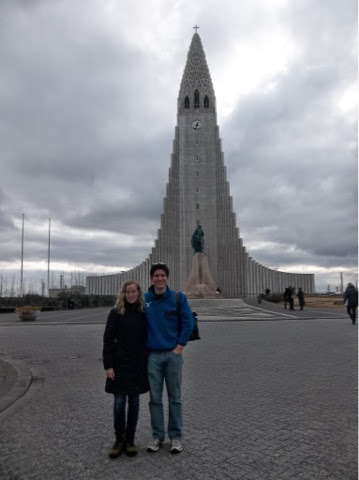
Feeling much better after a good night's sleep and a great run, we downed our skyr (Iceland's answer to Greek yogurt, but it's sweeter and actually a cheese) and set out to see more of huge city.  First, we took a brief pilgrimage to the giant Icelandic church, Hallgrímskirkja.  
The unique design of the church was the result of a 1929 design competition to build a church in honor of Iceland's famous devotional poet, Hallgrímur Pétursson.  The church was finally opened to the public in 1986, and has been an iconic building ever since.  The inside of the church is characterized by simplicity and light, and features works from famous Icelandic artists.  In addition to services, the church is also used for artistic and cultural events.
Interestingly, Iceland is one of the few countries that has always been inhabited by Christians.  This community of faith has been persecuted in the past, originally by the Norse Vikings, but has always remained a presence on the island.  The island did convert to Lutheranism in 1540 due to Danish influence, and now describes itself as an evangelical Lutheran community.  Currently, about 90% of the population is part of the Icelandic church.
For tourists, the best part of the church is the 73.5 meter tower, which offers views in every direction.  It gave us a real appreciation for the relatively small size of the city, the cheeky colored rooftops, and the rugged beauty where nature had refused to be domesticated.
After Hallgrímskirkja, we headed to another interesting structure, Perlan (or "Pearl") - a glass dome mounted on five large concrete water tanks. It's a surprising contrast in delicate elegant and stark industrial aesthetics.  A luxury restaurant, rated one of the "best rotating restaurant dining experiences in the world", adorns the top floor, while the true prize, a 360 degree viewing deck, is one floor down.  Here, too, we admired the views, which never disappoint.
Next, we ducked back to near the church for the tourist experience at Loki Cafe, where we tried a few bites of the Icelandic national dish: fermented shark.  
One order "to taste" came with four bites, and we fearlessly popped a bite each into our mouths.  Let's just say that it was a one-time experience.  We graciously forfeited the other two bites to an American tourist couple at the next table, who were about to order their own.  They agreed with us - no more fermented shark.  On the other hand, the rye bread ice cream, a Loki Cafe special, was INCREDIBLE.  Very yummy.

Since we had seen most of the major sites at this point, we decided to get a different perspective and listened to an audio tour of the literary sites around Reykjavik.  This app is free and you can download various audio tours.  It was a fun way to explore new neighborhoods and learn a little bit about Reykjavik's past through poems, short stories, and sagas.  The takeaway: the sagas involve a lot of behavior now seen at college parties, feminist poetry (at least the modern stuff) is largely about drinking and partying and having sex to protest The Man, and Jules Verne used a Swedish dictionary to insert "Icelandic" words into his classic Journey to the Center of the Earth.
A couple of other gems from that walk - feeding the ducks at Tjörnin is a must.  Look for the swan with the odd, twisted neck (swan scoliosis?) - he's our favorite.   There's also a large elf stone hidden in one of the neighborhoods.  We are now on the lookout for more.

For dinner, we went to Icelandic fish and chips, because we figured that on an Iceland with a booming fishing industry it is appropriate to try the fruits of their labor.  I got oven-baked cod in a sundried tomato and lemon pesto - delicious.  Josh got the lobster soup, but it could not live up to the quality of The Sea Baron's specialty.

Afterward, we stopped by The Volcano House to see the documentaries about the two major eruptions that have shaped Icelandic history recently - one in 1973 and the other in 2010 (yes, the one that probably ruined your vacation plans or stranded your friends - poor creatures - in Europe).  The documentary was $20 per person, so we skipped that and played with all the volcanic rocks.  It's incredible how light pumice is, with all of the air pockets running through it.  We played in the mini sandboxes of volcanic rubble, ran our fingers over basketball-sized chunks of obsidian, and nerded out over the physics behind the formation of spherical bulbs in the rock - trapped bits of gas expanding to minimize entropy.  Two sulky teens stood waiting for the bathroom, complaining about their boring six hours wandering the city this afternoon, including four hours "just sitting on a hill".  It was a reminder that adventure does not just fall into your lap; vacation is what you make it.

To finish the evening, we walked out to the water's edge and watched the sun go down.  What an incredible place.

Spotted: University students are the same everywhere!  We stopped by the University of Iceland to buy a t-shirt for one of Josh's coworkers and found a surprisingly familiar scene: hipsters, messenger bags, ready sources of caffeine, and overpriced textbooks.


Smoky Bay

Greetings from Reykjavik, capital of Iceland!
Josh (my boyfriend) and I arrived bright and early at 7 am on Sunday morning at the Keflavik airport.  This airport, which is just southwest of the capital, receives 95% of the traffic into the country.  The other 5% flies into the Reykjavik airport, a tiny little airport that provides a constant supply of small planes overhead throughout the day as you meander the side streets.  Why might this airport distinction be important? Because we had to take a bus into the city proper, and there our adventure begins.
We had booked FlyBus tickets into Reykjavik, as is customary (according to every travel book, forum, and blog ever).  We loaded up our bags and paused to admire the sunrise coming over the mountain ridge and casting rays along the rather rugged, flat Icelandic landscape.  Apparently we paused a moment too long, because we saw the bus begin to pull out of the lot and - as we chased it in vain - drive straight to the city.  Luckily, Iceland is a small country with relatively little crime, so the SOS BAGS ON BUS message was quickly relayed to the driver and our bags were waiting for us at our drop-off point, the BSI bus station, when we arrived on the next shuttle.  Not the best start, but we continued on undeterred.
To give you a sense of what Iceland looks like, picture a snickerdoodle that sat too long in the over, becoming brown and cracked.  Then cast chunks of volcanic rock, porous and deep black, over the jagged cracks and soften the picture with muted green lichen and moss.  Add snow-covered mountains, often flat-topped and blurred by cloud cover, as a border along the horizon.  Welcome to Iceland.
Reykjavik, on the other had, has a completely different feel.  Gone are the vast expanses cut by a thread of winding pavement and that favorite European traffic pattern - the roundabout.  In its place are a series of small buildings with highly colorful roofs but, except in a few hip neighborhoods, a rather austere and minimalist design.  The entire city stretches wide and large on a map but, within about 30 minutes, Josh and I realized that this city had a case of Venice syndrome and seemingly large distances could be covered in the span of 10 minutes.
The city seemed deserted upon our arrival as we walked among the statues bordering Tjörnin (the central lake), but we quickly realized that was because it was 8 am on a Sunday morning.  We ducked into Bergsson Mathús for breakfast and enjoyed homemade jams, bread, eggs, meats, and cheeses.  Afterward, we lounged we tea and pastries (and wifi) as we waited until check-in time.  I began to read Jules Verne's Journey to the Center of the Earth, which takes place in Iceland.  Great decision.  It was a good way to start a vacation.
Once we were able to drop off our bags, we roamed the city freely.  We started at the Kolaportid Flea Market, which takes place in a giant warehouse on Saturdays and Sundays.  The flea market was a fairly quiet affair, which surprised me.  The stalls were very casually staffed and there was none of the aggressive haggling that I have come to expect.  Nobody even asked you to step into their shop.  The only stall of interest to me was one selling vintage leather jackets, but once I realized that the woman was citing prices around $200 instead of $20 for the worn item, I lost interest and became more careful about applying the exchange rate.
We whiled away the early afternoon by stopping at City Hall to see the 3D map (couldn't find it) and then stopped by the famous Baejarins Betzu Pylsur, a simple hotdog stand that has has numerous famous international guests.  We stopped to try it, got it with "everything" as was recommended, and took a bite.  
It was a so-so hot dog covered in two sauces - one mayonnaise-based and the other brown and sweet- resting on a toasted bread bun and a bed of crunchy onion bits.  I thought the onion bits were a tasty touch but was not a fan, although Josh quite enjoyed his.  Judging by the crowd there at every hour, others apparently do, too.
To round out the afternoon, we stopped by the National Photography Museum (which showcased the work of unappreciated female photographers in the current exhibit) and the National Art Gallery, where we appreciated abstract art and collage works 
before making our way to the lower level and making our own collages for display.  Sadly, we were trumped by one prolific 8-year old artist who covered almost an entire wall by himself.  His best work is shown below.
For dinner, we stopped at The Sea Baron, a seafood restaurant on the water whose menu is a freezer filled with the various seafood you can order.  We had done our research and got their specialty, the steaming bowls of lobster soup served with plates of warm French bread.  We also got a few bits of cooked whale meat to try.  Sitting at long benches with other diners, we dug into our soup (delicious) and tried whale for the first time.  It was very seasoned and salty, and more than a little chewy, but it went down fine.  I think we were both glad that we had opted for the soup instead of the full whale steaks.  That soup could probably tempt me back to Iceland.
A few bits of whale meat, to taste

Giving in to jet lag, we collapsed into bed for the evening and watched a bit of The Secret Life of Walter Mitty to fully immerse ourselves in our Iceland adventure.  Movies, books, walks in the streets - we take our adventures very seriously.

Spotted: on many of the highways, Iceland only has lighting on one side.  Maybe most people are driving one direction in the evenings?

Spotted #2: Trolls! Icelanders love 'em, believe in 'em, and have giant figures of 'em in public!

Monday, July 29, 2013

Light and Darkness

On our last day in Israel, we finally made it to the one site that tied together so many loose ends on our trip: the Israel Museum.  At practically every historical site that we visited, we were told that the original stones, pottery, artifacts - basically all the cool stuff - has been moved to the Israel Museum.  Given that we saw replica artifacts stolen in several places, we completely understood.  But we still wanted to see the originals.

Upon arriving, we headed immediately to see the Dead Sea Scrolls.  
As mentioned in a previous post, these scrolls were found at Qumran in 1947 by Bedouin goat herders who threw a stone into a cave and heard pottery breaking.  Inside the cave were a series of scrolls, stored in clay pots, covered with ancient Hebrew writing.  The scrolls were sold several times before ending up in the museum.  They are about 2,000 years old (they vary in age by several hundred years) and are the oldest documents containing the stories of the Hebrew Bible.  All but about two books are represented among the many scrolls found in the original and surrounding caves, and they agree to a surprising degree with accounts written down hundreds of years later.  The scrolls were written by the Essenes, a peaceful sect that waited for the End of Days and lived communally.  Despite the terrible audioguide, it was fun to wander the room and see the various scrolls.  The longest ones found were over eight meters in length - that's quite a lot of writing.  And animal hides.

In the same exhibit was the Aleppo Codex, the second most ancient text.  
It is so-called because its last resting place before the museum was in Aleppo, Syria.  Sadly, when the state of Israel was declared, the synagogue where it was housed was burnt down.  Most of the codex was saved, buts one of the holiest bits were lost and the document remains incomplete.   They are still hoping that the other pieces will surface; one page fragment was carried around in a New Yorker's wallet for years after he picked it up in Aleppo in 1948, and was given to the museum after his death.  We all left the exhibit a bit mesmerized and hoping that someday we would stumble upon something ancient and important.

The other exhibit that we had hoped to see was one on Herod the Great.  We had visited so many of his constructions: Masada, Caesaria, Bet She'an, Jerusalem.  And the exhibit was great.  Herod the Great was really something: he imported the most expensive eyes to color his frescos, like the red cinnabar dye quarried in Spain.  He had wines, fish sauces, and other consumables sent from around the Mediterranean and distributed among his palace so that he and his guests would dine in style.  He schmoozed with Caesars and was seduced by Cleopatra.  He was cruel, paranoid, shrewd, exacting, and imaginative.  Much of what we know about him, including his bad reputation, is from "The Jewish War and Jewish Antiquities" by Joseohus Flavius, a Jew who worked for Rome.  The copies of his works in the exhibit include a 1470 printing... That's only 15 years after the Gutenberg Bible, and Tia in immaculate condition.  Anyway, he was really something.  They say he was obsessed with building because he wanted to immortalized himself, and I think that he was quite successful.
From a video on Masada that was part of the exhibit.

Saturday evening, we were initiated into another Jewish ritual: Havdalah.  This short, beautiful service welcomes the new week and often includes music and dancing.  It is a celebration of opposites: man and woman, light and dark, etc.  For our Havdalah service, we snuck into a beautiful garden just a block or two from our hotel.  For the service, a braided candle with two intertwined wicks is burned and, after the prayers are said, is extinguished in the last liquid of a glass of wine (mostly consumed by the person leading the prayers).  The candle is then removed and people dab wine on their forehead for wisdom, the back of the head/neck for health, and the pockets for money.  According to Dana, a man once asked Shimon (her husband) why people only dabbed a little bit of wine on the pockets for money and Simon replied that you could use as much as you wanted.  The man poured the entire glass in his pocket and, as luck would have it, won the lottery the very next week.  Happy Havdalah!

Spotted: toilet paper.  Or, rather, a lack of toilet paper.  Be careful when using public restrooms on Shabbat!  There's nobody to restock or clean the bathrooms and things get quite messy.

A Memorial and a Name

Note: no pictures were allowed at the two places that I went today, so there are only two photos in this post.

On Friday morning, we set out for Yad Vashem, or the Holocaust Museum of Israel.  
While I have been to others, such as those in Washington, D.C. and Berlin, this exhibit was quite different.  For example, the beginning of the exhibit is a history of anti-Semitism dating back thousands of years.  It features medieval paintings of Jews sacrificing Christian children and using their blood to make matzoh.  There has been some pretty sick stuff said about the Jewish people.  But perhaps the most surprising was this quote and its origins: "The Jews are our misfortune."  While this quote is attributed to Von Treitschke, one of Hitler's "favorite anti-Semites" (in the words of our guide, a cynical former prosecutor from New Jersey), it is actually a quote from Martin Luther, albeit out of context.  Luther was perplexed by the Catholic obsession with punishing Jews for killing Jesus, though later in his life he became quite anti-Semitic and advocated burning down all the synagogues in Europe.

Anyway, it would be impossible for me to do Yad Vashem justice through my description, especially without taking hours to do so, so I will simply share some facts and anecdotes that jumped out to me during the visit. Note: a lot of the information below is disturbing and depressing.

The building was designed in 2005 and is built in stark, bare concrete to look like a scar on the mountainside, since the Holocaust is a scar on the history of mankind.  A skylight runs the length of the building to remind people that these events happened in broad daylight.

A group of Polish Jews were taken by the Nazis and killed just before the Soviets could liberate them. The bodies were burned, but in a hurry, such that many of the documents in the victims' pockets survived.  One of the victims was Jakub Noach-Lewis, a young man who has been admitted to medical school in Switzerland for the fall of 1940 but who was sent away by the Nazis before he could matriculated.  Sadly, he would have been safe in Switzerland, if be had only reached it in time.

German Jews has one of the lowest mortality rates of any of the Nazi-controlled countries, because at first the government tried to force them to emigrate.  It was only later that more drastic measures were taken, and these measures were extended to other countries that were conquered.

Very few Italian Jews died, relatively, because the Italian population was not notably anti-Semitic.  Mussolini's first mistress was actually Jewish, and he protected her even after he abandoned her for a second, non-Jewish mistress.

One of the concentration camps, Sobibor, used carbon dioxide in the gas chambers.  This was fairly inefficient; it took 30-60 minutes for people to die and, since it rose, often left the young children alive.  They had to be killed afterward by the guards.

The name Yad Vashem comes from Isaac, 56:5, which reads: "I shall give them in my house and within my walls a memorial and a name."

We ended our tour with a visit to the Children's Museum, which was one of the first parts of the museum to be completed.  In a darkened room, give candles sit in a case in the middle and hundreds of mirrors on the walls reflect the light millions of times, creating stars above and beneath that sparkle. It is beautiful, and so simple.  I highly recommend visiting.

Since Friday evening marked the beginning of Shabbat, we joined a merry throng walking to the Western Wall to observe the Friday night rituals.  
Frustratingly, women have to stand to the sides or behind the main area, where men gather, socialize, dance, and generally work themselves into a holy ecstasy.  Women wait dutifully for their husbands, pray in silence, and peek over the divide.  As my mother irreverently put it, "I feel like I'm in a harem or some thing, peering from behind this screen."  Verdict: Not recommended for feminists.

We soon departed for a beautiful Shabbat dinner of song and, as usual, thousands of courses of food. The locals and a few brave guests partied long into the night, while the rest of us trudged off to bed, full of food and desirous of sleep.

Spotted: Jesse Owens in the Holocaust Museum.  In the 1936 Olympics when he won his record 4 golds in track and field at a single Olympics, he was entered in a race in which he was originally not slated to participate.  A pro-Nazi member of the American Olympic Committee convinced the rest of the Committee that having Jewish competitors win would be too much of an affront to Hitler, so Owens was out in to replace one of the Jewish members of the relay team.  The snubbed runner never got over it, despite a successful career.  But he and Owens were lifelong friends.

Spotted 2: Giant furry donut hats.  These are worn by the super ultra Orthodox and look terribly uncomfortable for a hot summer evening.

Walled Out

After a disappointing group tour of the New City, we were hopeful for our private tour of the Old City on Thursday.  Ronan, a friend of the groom's and a tour guide for 15 years (albeit an engineer by education) was wonderful. He began with a brief history of the land of Israel and, in particular, of Jerusalem, helping us to contextual ice all that we had heard about the various incarnations of the Temple Mount and why it even existed in the first place.  His history lesson also tied in other things that we had learned during the course of our trip.  For example, one of the main gates to Jerusalem is Jaffa Gate, which is so named because the road from Jaffa Port led straight up to it.  We had been to Jaffa and learned about its historic role as a port in this region; it was the longest-running active port until it was finally replaced in 1967 by the adjacent port in Tel Aviv.
And now a word about these gates.  This city was a fortress: the gates were thick and high, with a double gate, slits for archers, and special holes through while boiling oil could be poured down on attackers.  Today, the city gates stand open but it is internally divided into four quarters, listed from biggest to smallest: the Muslim Quarter, the Christian Quarter, the Armenian Quarter, and the Jewish Quarter.  Yep, the Jewish Quarter is the smallest.  And the Armenian Quarter is Christian but because they got here before all the other Christians (basically before Rome converted to Christianity), they get their own sector.

While Jerusalem is very much a living city, it has also been excavated to reveal the history beneath.  The two Cardos (main streets in a Roman city) can be seen, excavated below main arteries of modern commerce.  Archaeological sites such as the Herodian Quarter (within the Jewish Quarter) reveal the giant chambers of a high priest and indicate the social strife of millennia past.  Mosaic floors, stucco walls, mikvahs (ritual baths), pottery shards, carvings of a menorah (the oldest known menorah representation in existence), Roman spearheads, and other finding help to educate us about the past buried beneath our feet.  One can't help but wonder what other mysteries lie beneath the modern city.
Since Ronan, like Danny, seems to know everyone, we got to enter a yeshiva that had just finished hosting a bar mitzvah and... Beheld a spectacular view of the Western Wall and the mosque with the golden Dome.  
When the Muslims conquered Jerusalem, they built a mosque over the ruins of the previous temples, in the spot where Abraham was ready to offer his son Isaac as sacrifice to God.  As an Abrahamian religion, the Muslims also consider this site holy.  Sadly, due to political divides between religions, Jewish pilgrims are not allowed even on the plaza around the mosque, and Christians are allowed on the plaza but not within the mosque, so neither of the other Abrahamian religions can worship at this holy site.  For this reason, the Western Wall - the closest accessible point to the site of (attempted) sacrifice - has become the new holy site for the Jewish people.  It is unknown why, in 1967 when the Jewish fighters recaptured Jerusalem, they did not tear down the mosque and begin the construction of a new temple.  But that decision has meant that they do not have access to the temple and most content themselves with the wall.

The wall is one of four retaining walls built by Herod to create a flat plaza around the religious site and is a marvel of engineering.  Only a small portion of the wall is visible above ground today, but underground tunnels beneath the Muslim Quarter show the length of the wall and the giant rocks quarried to build it.  The longest one weighs over 250 tons and they are not sure exactly how it was moved there.
In comparison, the Christian sites are rather bland.  The Church of the Holy Sepulcre is at the end of the Via Dolorosa, the path that Christ supposedly took while hauling his own cross to the site where he was crucified. Three of the stages of the cross took place inside the church: the crucifixion, the washing of the body, and the burial in a cave.  Since these are about 50 steps from each other and all of these events are thought to have occurred outside of the city, the sites hold no real significance for those who prefer rationality to blind belief.  
See the walled city in the background behind Jesus?  Even the mural IN the church suggests that these events didn't happen here!
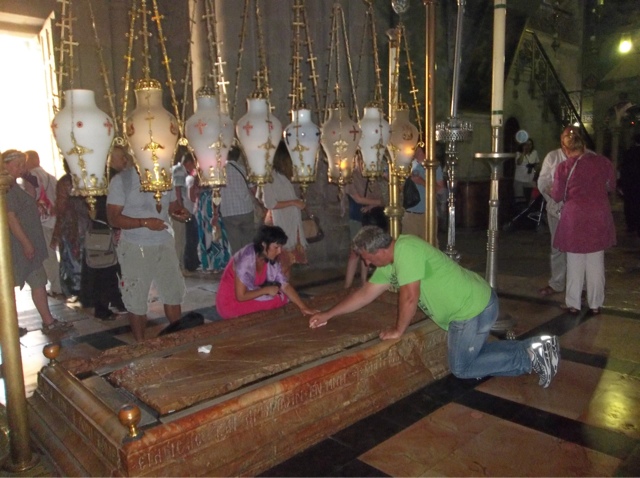
The stone upon which they say Christ's body was buried is apparently from the 1930s.  Most of the pilgrims inside are of Eastern European origin and rub scarves and other belongings on the stone in the belief that holiness can be transported inside material things; they bring ashes from candles burned within the church home to their parishes.  
The site is also part of a divisive power struggle between twelve sects, who block each other whenever possible.  The rivalry is so bad that a trusted Muslim family holds the keys because the Christians can't trust each other.  It's just sad.  The interesting part about the Church of the Holy Sepulcre is that it was originally built by Helena, mother of Constantine, after he converted the Roman Empire to Christianity.  It was one of the four churches she first built on holy sites.  The original, sadly, was mostly destroyed.  The current version is about half the size and was built by the Crusaders on the same site.

As we retraced our steps through the city, we wandered through the Muslim Quarter bazaar, which was like any other market: kitschy merchandise alongside fresh produce and gleaming sweets.  There were quite a few pro-Palestinian shirts, often right next to an I <3 Israel display.  It was quite strange, and also quite telling.

Two days in, Jerusalem continues to surprise, delight, and befuddle.
Yes, that is an antique rifle sticking out of a window hanging of flowers.

So many Spottings:

1. Cohen.  This is derived for the name of the families of high priests/rabbis.  Those who have this last name are descendants of those families.

2. Garbage tractors.  Small ramps have been built into the ancient steps of the city for the purpose of garbage collection.  Small tractors navigate the narrow streets, three times as tall as they are wide as they accumulate the city's waste.  They often skim the tops of archways, but always miraculously pass through.

3. Fireworks in the Muslim Quarter.  In the evening, these are set off by Muslims celebrating the end of fasting on the days of Ramadan.  But this morning they were being set off to celebrate the end of school exams.

4.  Hats.  It's very strange to go into a building, take my hat off out of respect, and be scolded for not respectfully keeping it on.  Covering your head is in here.

Love and War

Our day started with a rather mediocre tour of the New City, from which I gleaned only this:
When there was a large demilitarized zone (1948-1967) between the Jordanian-controlled Old City and the Israeli-controlled suburbs, a nun lost her dentures in the DMZ and had to be escorted by a Jordanian, an Israeli, and a UN representative waving a white flag to get them back.

After over a week in Israel, we finally made it to the event that started it all: the wedding of our family friend Dana.  While I had been to a few Jewish weddings in the United States, they were completely different from the Orthodox Israeli marriage festival that unfolded before my eyes on Wednesday night. We boarded giant buses at the hotel and were whisked away to kibbutz just outside the city.  In case you haven't caught this from previous posts, gone are the days of shotguns and backbreaking farming on most of these kibbutzim.  This one specialized in event planning, providing both the space, staff, and catering services to make your event run smoothly.

As we disembarked, we added ourselves to the throng of happy wedding guests mingling on a wooden patio, frequenting the (kosher) appetizer stations serving small sausages, soft tacos, sushi, fruit smoothies, and a variety of other finger foods.  The drink was available for those who wanted something (much) stronger; drinks were poured strong and people loosened up quickly - especially the orthodox guests who self-segregated by gender on opposite sides of the patio.

We walked further back to a clearing where Dana sat on a small bench and blessed her guests.  Sitting in a flowing white lace dress among greenery and flowers, she looks like an Israeli Titania, tended by family members and supplicants.  But mostly she was just our beautiful friend, a giant, irrepressible smile stretching from ear to ear.  Meanwhile, back at the patio, her groom-to-be shared her grin and was enthusiastically greeting guests.

After about an hour, a group of Orthodox men gathered around the groom and danced in a circle, singing louder and louder, accompanied by an unlikely trio of saxophone, flute, and acoustic guitar.  The men escorted the groom in a parade of song down to where the bride sat, flanked by her mother and future mother-in-law.  The women crowded around Dana, and again it was a curious face-off of men and women.  In days past, this ritual is to allow the groom to confirm that he's got the right bride. Or perhaps it has present relevance, too - a large number of Orthodox weddings are still arranged, which perhaps isn't so surprising in a culture where men and women do not touch affectionately outside of the family.
Bride confirmed and grins still firmly in place, the couple was swept up on a tidal wave of guests, the milling crowd pressing onward to the chupah.  While the American guests meekly took their seats, the Israelis crowded right up their with the couple; their laughter could be heard in the background on the microphone as the evening's narrator/MC called people up to read or give blessings.
If nothing else, an orthodox wedding in Israel is a celebration.  People serenaded the couple with traditional songs, joining the chorus with gusto.  There were cheers; more people crowed the chupah. Then the couple was coming back down the aisle with people singing and dancing and again a tidal wave of celebration brought us back to the entrance.  
Here, the couple was ceremoniously dropped as the thirsty, hungry guests (it was now 9 or 10 pm) filed into the reception and the couple was left alone. Traditionally, this is where the couple "touches" for the first time and they were greeted with lusty cheers when they rejoined us in the reception hall.

The rest of the evening was spent alternating between numerous courses of (kosher) food and dancing in gender-separated areas.  The women were given pom poms, whipped into frenzied circles, thrown in tongue center to dance with Dana, and otherwise egged on by a single woman who I never managed to identify as anything other than "Stripes" (so called because of her dress pattern).  The men's side (which I snuck over to observe, having no reservations about seeing the other gender dance) needed no such invitation.  They were mad men - grinding, swiveling, flailing, jumping, squatting, springing, twirling, do-si-doing, clapping, waving napkins.  Several of their moves looked like poorly-executed amateur break-dancing, but they gave it their all.  And then the strangest part happened.  Dana and her groom were lifted on chairs, each on their respective side, as if teasing each other from opposite sides of the wall.  Stripes gave Dana a giant parasol with ribbons hanging down, but nobody had any idea what to do with it (least of all Dana).  
It was odd, it was hilarious, it was festive.  Nobody knew what was going on but they enjoyed the chaos.  And while my grandma-bedtime self left on the first bus (at around 1 am), the party raged for hours.  This didn't surprise me in the least, since one of the last things I saw was a very drunk young man throwing a bottle of Belvedere high into the air in complicated flipping patterns and attempting to catch it.

Israelis definitely know how to party.