Wednesday, March 11, 2015

The 99.999999%

Today, I learned that childbearing used to be a race with the grand prize of having a pretty fantastic amount of power over other people's lives... and it prevented you from getting kicked out of your house.  At least, that's how things were at Topkapi Palace among the wives and "favorites" of the sultan.  The woman who produced the first heir eventually became the Sultan Mother, and for at least two centuries of Ottoman history, these women held far more power than the sultans themselves.  This is attributed to (and potentially caused) the laziness and dimwittedness of many of the sultans during this era, but it's still pretty interesting that the Sultan Mother did everything but wage war.

As you may have guessed, we explored the Topkapi Palace today, seeing how the 0.000001% lived and feeling very much like the 99.999999%.  Why no, I don't have 1,000-piece sets of china from Sevres given to me as gifts.  I also don't own an 86-carat diamond (known as the Spoonmaker's Diamond for its fabled discovery story), the supposed sword of David (as in, biblical David), or a giant to-scale replica of the Dome of the Rock made entirely out of mother-of-pearl.  Sadly, I was not allowed to take pictures of any of these things, but you'll have to take my word for it that all gems were enormous; there were a whole lot of relics that pretty much covered the Who's Who of Judaism, Christianity, and Islam; and the things that sultans had bedazzled bordered on the absurd.

The Topkapi Palace is an enormous complex that began as a single, fairly modest palace (as palaces go), since the ruler at the time felt that decadence would be against his religious beliefs.  Each successive sultan added a room or a building for the next 400 years or so, resulting in a sprawl of bulidings in every architectural style, often constructed to celebrate a particular military victory or house a particular ceremony (i.e. the Circumcision Room, which I hope wasn't used more often than was necessary).  As you enter the complex, you first reach the First Courtyard.  This open space is deceptive; it used to be crowded with wooden buildings until they all burned down.  It still houses the Hagia Irene (Irene Church), which we did not explore, but is mostly just a beautiful and quiet place to walk.  Next, you buy tickets to enter the complex proper, which consists of the Second and Third Courtyards and their buildings.  
Once in the second courtyard, Topkapi Palace is your oyster.

Since we got there early and beat the crowds, we went to all the most popular places first to avoid inevitable lines.  We started with the harem.  Whenever you hear about this harem, guides are quick to point out that real life deviated from fantasy (when does it not?).  The sultan only slept with his wives and a very small, select group of the concubines.  The rest were sort of just... there and apparently were often released after a few years.  There was apparently a very strict structure in the harem, which was ruled by the Sultan Mother.  In fact, she basically got to pick which people her son slept with and married.  The harem was guarded by eunuchs and is a beautifully tiled labyrinth.  
It holds small mosques, long corridors, small squares, sleeping quarters, rows of faucets for ablutions, and then the lavish quarters of the Sultan Mother.  I'm pretty sure that this is from the Sultan Mother's quarters, but I have literally thought about the beauty of these windows since I was here four years ago, and they were equally stunning now.
  
Obviously, the photo does not do them justice, but they are the most perfect shade of aquamarine.  The harem also connects into the living quarters, privy, and ceremonial rooms of the sultan himself.  Imagine celebrating in this kind of style:

Anyway, the beautiful tiling of the harem is definitely one of my favorite parts of Topkapi Palace.  Next, we stopped by the treasury and the relic rooms, which I mentioned at the beginning of my post.  The wealth of the elite several hundred years ago was absurd.  I can't even imagine what birthdays were like. Did they celebrate birthdays?  Anyway, the sheer number of precious stones they crammed onto things was impressive.  You could notice how jewelry has improved over the years, though, particularly the ability to cut stones so that they reflect the light.

Next, we roamed the other rooms that were gradually added to the palace, like this one:
We also stopped by the various fountains, looked at an incredible number of decorative spoons, and pondered whether the bowls lined with rubies were just for show - I mean, what if one came loose and you chomped down on it?

As we left the palace, the midday call to prayer was just beginning.  We realized that it was done as a sort of conversation between the Blue Mosque and the Hagia Sofia - the call would alternate between the two buildings' spires.  We wandered back toward the main square by the Blue Mosque to check out the Hippodrome and a few other ancient structures, or at least what is left of them.  The hippodrome was built by the Roman Emperor Septimius Severus toward the end of the 2nd century and then extended by Constantine the Great.  It could seat between thirty and sixty thousand people, depending on which archaeologist you ask, and was the main attraction in Roman and Byzantine times.  It hosted chariot races, gladiator fights, musicians, dancers, and other public celebrations.  Successful chariot drivers were fabulously wealthy, could have anything they wanted, and were supported by clubs that quarrelled endlessly and jockeyed for position.  As Josh put it, chariot drivers were the NBA players of their day.  Today, only a small portion of the Hippodrome exists, and it is encased in glass at the Museum of Turkish and Islamic Art.  The rest was hauled away to build private homes, of which remain small patches of ruins.  
 
(This path used to be the Hippodrome track)

The other ancient structures were the obelisk and the serpent column.  The obelisk is from 1490 BC and was hauled here from Egypt.  The official posting offers the best description ever: "In the 4th century AD, an unknown Roman emperor who wanted to accomplish something impressive that would create excitement among his people had the colossal obelisk brought to Istanbul."  Ouch.  Way to forget his name and gloss over his accomplishments.  I mean, the thing is 25.6 meters tall.  That's like moving one of the moai from Easter Island, or one of those giant stones from Stonehenge.
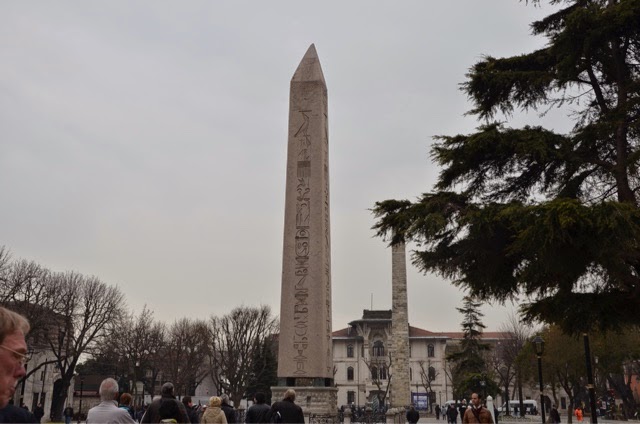
The serpent column was also stolen; it was originally at the Temple of Apollo in Delphi and was brought here in 324 by Constantine to stand in the middle of the Hippodrome.  Three intertwined serpents held a giant gold cauldron on their heads, but sadly the heads (and cauldron?) disappeared around 1700.

Since we were in the mood for historic art, we stopped by the Turkish and Islamic Art Museum.  We saw art from a variety of early Islamic nations, including a large number of beautiful illuminated manuscripts (a personal favorite).  The museum also holds the Damascus Documents, which represent one of the first written copies of the Qur'an.  There were a variety of other media, like sculpted wood, pottery, lamps, etc, all decorated with Arabic writing (presumably verses of the Qur'an).  Some were incredibly beautiful, especially the painted lamps.  There were a few pieces of art depicting people as well as some small sculptures of animals - I guess they didn't get the memo that such art is discouraged.  The exhibits also contained Keys to the Kabba, a sort of key-to-the-city to the holiest place in Mecca.  However, the majority was decorated in the typical Islamic style.  It did get a little bit repetitive, to be honest, but was still beautiful.  Near the end, there was a series of beautiful carpets and some beautiful furniture, all more modern than the previous exhibits.  It was a nice overview of art across the nearby regions.  My personal favorite from the entire museum was this astrolabe:
An astrolabe is a very ancient astronomical computer for solving problems relating to time and the position of the sun and stars in the sky.  The celestial sphere is projected onto the plane of the equator.  It also looks awesome.  Doesn't it just beg to be taken on an adventure?

Exhausted from a long day on our feet, we headed back to the hotel.  But there was one last surprise waiting for us.  A farmer's market!  I'm not sure how often this happens, but definitely take a look at the end of Gelinik Street on Wednesdays if you're ever in the city.  Gorgeous produce - including the freshest, happiest-looking eggplants I have ever seen - was lined up along the tables.  We gleefully picked out some produce and happily muched the whole way home.


Tuesday, March 10, 2015

Chocklava

If you need to exchange cash in Istanbul, there are many places to do it. However, the fairness of these exchanges varies dramatically based on where you are in the city.  The airport exchange is relatively fair, but they charge a large commission on top of everything (4%).  The exchanges near Sultanahmet are incredibly unfair (20 lira cent (?) spread between buy and sell prices), while those dotted around the city vary.  From our (limited) experience, some of the exchanges at the Grand Bazaar seem to have the best rates.  We found one offering $1 to 2.60TL, and when we went this morning, they actually gave us a higher price than the one listed outside their shop.  Anyway, next time I come this will definitely be where I exchange money.

Going to the bazaar when it opened (9 am) was such a pleasant experience.  We had expected to be in and out but found ourselves slowing down and amiring wares.  Why?  Because all of the shop owners were enjoying their breakfasts, sipping the tea that was brought directly to them by a small army of wandering waiters (unlike in the US, these waiters will walk several blocks throughout the city delivering food and tea around mealtimes) and catching up.  
Not a single person shouted "where you from?", tried to maneuver us into their shop, or even seemed to notice our presence.  It was oddly magical.  Josh and I turned to comment on this at the same time, and just then the first vendor finished his food, stood up, and said "Please, miss, mister, come into my shop.  I have beautiful scarves."  The magic was gone, and with a laugh we made our way back outside.

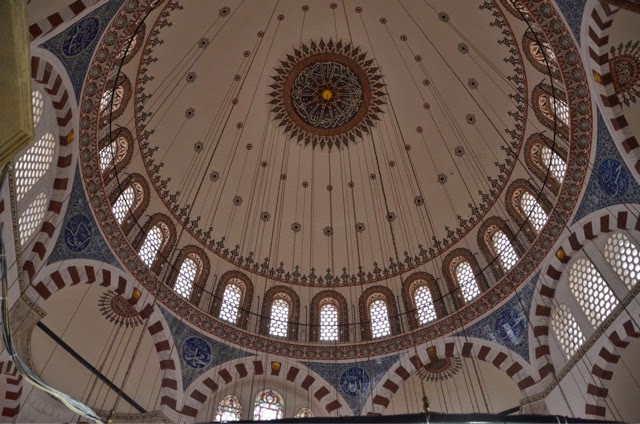
Today's agenda involved a lot of walking, starting in the heart of Sultanahmet, crossing the Galata Bridge, and exploring the new city on the other side of the Golden Horn.  Our first stop was the Rüstempasa Mosque (Rüstempasa Camii).  Built in 1560, it was designed by Mimar Sinan (just like the Suleiman Mosque) and has semi-domes surrounding a main dome.  It is one of the most embellished mosques of the Ottomans.  The mosque was destroyed by the cumulative effect of earthquakes and fires, but it was repaired in the mid-1990s and is now offers a brief respite from the noise of the city.  Unlike the Suleiman mosque, though, the Rüstempasa Mosque is rather hard to find.  It's very close to the waterfront and the spice market, yet its entrance is an inconspicuous doorway off a side alley.  We realized that we had walked by it a half dozen times already, never noticing the humble placard nailed to the arched doorway.
It was certainly beautiful, and we were grateful to have the recommendation to stop by from a friend who had previously visited Istanbul.  Hurray for crowdsourcing your travel itinerary!

Next, we walked the Galata bridge toward the new city, curious to see whether the "modern Istanbul" was all it was cracked up to be.  We passed even more fishermen, creating a sea of undulating fishing rods as they tensed and slackened their lines.  If you look closely, you may notice an L-shaped piece of wood with a triangle cut out of each end.  Every fisherman had one of these, as well as a bungee cord to hold it in place, as a fishing pole rest (for when they'd grown tired of waving their poles about, I guess).

On the other side of the bridge, we huffed up some hills, narrowly escaping the reckless drivers of Istanbul, until we reached the Galata Tower.  This 205-foot-tall stone tower was bulit by the Genoese in the mid-14th century (alright, I guess this district isn't entirely new) and has been used as a fire tower, barracks, dungeon, and launch pad for human-powered flight.  
Hezarfen Ahmet Celebi, a 17th-century aviation pioneer, was so inspired by Leonardo da Vinci's work that he built his own set of artificial wings and hand-glinded several miles from the top of the tower to the Asian side of Istanbul, all the way across the Bosphorus.  Now, of course, the tower is merely a tourist attraction, known for its views of the city.  We had planned to go up to the top, but the price had doubled (cheap student tourist alert!) and so we wandered on, content with the gorgeous views that the city has already provided.

Several blocks from the tower, the modern Istanbul gets going.  The heartbeat of this younger, more hip part of the city is Istiklal Caddesi, or Independence Avenue.  Modern seemed to mean "full of international brands", so we saw quite a few familiar names, from Krispy Kreme and Shake Shack to Gap.  Modern also seemed to mean "full of graffiti", some of which was rather disturbing if painstakingly painted (though I didn't photograph those).  And, often, there was graffiti-style art in English decorating the shops.
We wandered all the way to Taksim Square, at the far end of Istiklal Avenue.  The square is supposed to be the center of this "new city" portion of Istanbul, but the only people there seemed to be tourists.  At least around tourists we got a break (to some degree) from all the smoking.  People will sell you cigarettes - or loose tobacco for hand-rolling - at every corner.

On the way home, we stopped for dinner and I decided to try an Istanbul special: a "Fish bread" (or fish sandwich) straight off of a fishing boat.  You can't really see the boat behind the restaurant facade, but there is a boat rocking just off the pier with a giant load of freshly caught fish and an equally giant grill.  Stuff a fish fillet, some lettuce, and a few onions into some bread and you're good to go.  On the little casks-turned-tables, there are also sport-top water bottles filled with lemon juice for some added flavor.

To finish the day, we went on a brief pilgrimage.  Perhaps not a traditional one, but it was one that I had planned to do for a long time.
And so we journeyed to Karaköy Güllüoglu, home of the best baklava in all of Istanbul.  My research turned up reviews such as this one: "Oh my God!  We just love it... I & my friends eat in the shop.  We got some for home.  I got six kilos for my friends in UAE!  It is the best in the world.  Once in a lifetime."
Six kilos... SIX KILOS??? That's 1/4 of your entire weight limit for a checked bag.  And since this is made fresh and without preservatives, it doesn't last very long.  Other reviews were similarly glowing, discussing how this was (1) worth completely reversing all progress on your current diet, (2) spending absurd amounts of money to try one of every type of baklava (uncertain how they did this; there are about 30 types), and (3) how the chocolate baklava (what I like to call chocklava) would blow your mind with its dessert mash-up goodness.  How could a baklava-lover like me not go?  I mean, I once bought so many orders of baklava at a restaurant that they started giving me a free one with every purchase. (It was a great afternoon.)  Therefore, we found ourselves at the counter of Karaköy Güllüoglu.
They have an entire separate wall (the one shown) just for take-out orders; the other two walls are for people who choose to eat in.  We loaded up a half-kilo box sampler with "normal" (unsure of the real name), chocklava, some dumpling-shaped ones, and a pistachio one that basically has no pastry (just extra nuts).
I will admit, this baklava didn't change my life.  But it is delicious, very fresh, and uses only honey instead of dabbling in other sweeteners.  While I enjoyed trying a variety of flavors, I like the traditional baklava best.  The chocklava was not my favorite (although Josh loved it) and the pistachio one lost the balance of flavors that has inspired my love.  Definitely worth a visit.  Apparently you're supposed to follow your baklava with a sip of limonata when you eat in the restaurant, but since we took ours to go we didn't get to experience this important ritual.  
Also, possibly the most important art we have seen:

Spotted #1: Counterfeit money.  Among the many things sold on the street, counterfeit money has been the most surprising.  Or, at least, that's what it looks like.  We haven't stopped to engage these street vendors, who have rubber-banded stacks of paper that looks like various currencies.  We have seen enough to notice that the bills look slightly off.  The 5TL signs on top of a stack have put us off from the notion that perhaps they are just money exchangers... as does the fact that they will often leave their booths unattended.   The money doesn't look convincing enough to use, so we're slightly baffled as to why anyone would buy it (not that we have witnessed any transactions).

Spotted #2: Really endearing typos.  These pop up all over the city and can be found on every menu, pamplet, and sign if you look closely enough.  Our favorite was a restaurant that had carefully blacked out the typos on each pamphlet with a marker, but when you looked under a light you could read that they had accidentally described their shop as (blacked out parts in brackets) "A nostalgic [views], service the most [un]professional".

Monday, March 9, 2015

Bay Area

Day two began with a blustery run along the coastline and a revelation: Istanbul (especially in March) is a lot like San Francisco.  It has winding little streets that run seemingly vertically up hills, an overcast sky and a whole lot of wind, a bay (here, the Golden Horn), a suspension bridge merely lacking the International Orange finish, and a melting pot feel where east meets west.  That said, it's a whole lot more affordable here, to the point where human labor is the norm.  It took us all day but we realized that these flattened backpack-looking things we had seen tipped against the sidewalk walls in the morning were actually bases upon which giant loads could be strapped for transport to restaurants and shops far from the waterfront. (You can see the base of the backpack peeking out beneath the teal pillow-looking thing)
Men hinge over at a 90 degree angle, their backs to the opened back doors of a truck, and giant sacks, boxes, and pallets of cheap goods are strapped to their backs.  When we learned later in the day that 10-20% of Turkey's residents are unemployed, this cheap labor made a bit more sense.  It still had the uncomfortable taste of the miserable Chinese porters, though.  At least these guys didn't have to climb a mountain?

Our morning was spent as a sort of Intro to Istanbul Tourism.  We began at the Grand Bazaar, because why not?  It has a little bit of everything.  Since neither of us has a strong desire to purchase any shirts, shoes, jackets, scarves, tea sets, jewelry, or bowls, we made few friends.  Still, it was fun poking around.  Our favorite discovery was actually outside of the Grand Bazaar, at a small little stand.  It looked like a stapler but....
It was a tiny handheld sewing machine!  I was very tempted to get one so that I could sew additional pockets into my white coat.

Next, we went to the Suleiman Mosque.
The interesting part about this mosque is that it is one of the simplest in the city, and yet it is considered the most magnificent and beautiful.  Sadly, most tourists only hear about and explore the Blue Mosque, which is much more ornate (although I still like it).  The Suleiman Mosque has a faint blue color, simple but elegant tiling on the inside, a domes-supporting-dome structure borrowed from the Hagia Sofia (more on that in a future post), and elegant gardens.  It was designed by Mimar Sinan (architect for 3 sultans in a row!), was completed in 1557, and set the standard for mosque construction around the world.  Walking the grounds felt like entering an oasis from the non-stop conversations with the seemingly bred-for-extroversion Turks.  It also brought us a gorgeous view of the city.

Our third stop was the Spice Market.  Josh got to try Turkish Delight for the first time, and we wandered around breathing in the fumes of dried teas and mounded spices.  We also ended up in a sort of market extension off to one side where they sold mainly roosters, plant seeds/bulbs, and (most surprisingly) live leeches.  There are surprises around every corner here, if you bother to look.

We were scheduled to go on an afternoon bosophorus tour, but we had a bit more time before launching, so we walked a bit of the Galata Bridge only to find.... MOON JELLIES!  I'm not sure how visible they are in this picture, but there were hundreds of them just beneath the surface of the water.
After several trips to the National Aquarium, I was well prepared to appreciate the four semicircles on the back of these jellies and identify them.  My favorite moon jellies have always been the pinkie-nail-size ones, but any sighting in the wild was pretty exciting.

At last, we boarded our Bosphorus cruise ship.  We had decided on the 2-hour "Circle Tour" rather than the 6-hour all-day trip.  There is only so much residential skyline one can appreciate, and even a pristine island seen by horse-drawn carriage is anticlimactic in a gray haze.  There were a couple of very beautiful buildings along the way, though, including mosques, mansions, and a gorgeous building that is apparently the "Versailles of Turkey".  We also watched as dozesns of seagulls accompanied the ship, snapping bits of simit (the Turkish sesame seed-covered bagel-ish circles, http://en.m.wikipedia.org/wiki/Simit) out of the air as a woman in conservative Islamic dress stood on a bench and hurled them out the window, laughing in pure delight.  

The gentle rocking of the ship was the perfect way to relax after a day of aggressive sight-seeing and city-walking.  We had roamed touristy neighborhoods, hiked more authentic-seeming residential streets, and appreciated the fact that literally everything (scales, Barbies, juicers, zippers, six foot tall spoons) is sold on the streets of Istanbul.  But the best part is wandering around and soaking it up for free.

Spotted: Some things are universal.  Like no line for the men's bathroom, and one that's out the door for the women's bathroom.
Note to future travelers here: you have to pay to use the public restrooms (WCs), so keep coins handy!

Sunday, March 8, 2015

Istanfull

Today begins the next great adventure!  After a few weekend trips to various American cities, Josh and I are back in Europe.  We're planning to see Istanbul, Athens, and Delphi over the next week and a half.  With five hours in Istanbul (including the airport), under my belt, I have a few observations to offer.  

(1) It's Women's Day! (Apparently.)  We stopped at the tourist information booth at the airport, and I was immediately presented with a bouquet of carnations and had my photograph taken with the whole crew of information-givers (note: several carnations were lost in transit... that's the price of public transportation).  
It's currently unclear "Women's Day" is and how often it takes place, but it was a nice welcome.  Of course, my initial reaction was "how much money are they going to ask for after I take the flowers?", but I figured that was less likely to happen inside an airport at an official tourist information booth.

(2) There are a lot of stray animals here.  In doorways, in alleys, conked out in public spaces, or begging in the middle of busy streets.  Some are really cute.  Others make me wonder when I got my last rabies shot.

(3) There is a place called Batman, Turkey.  Could this be where the Justice League meets?

Since our flight didn't land until 4:30 pm this afternoon, we caught the sunset and the gentle end-of-the-day hustle as we wound our way from the airport into the city on the tram.  Neon signs sizzled on store fronts, pashminas tended by lounging men blanketed the sidewalks, and wind whipped around the massive historic landmarks that loomed over everything.  A hazy call to prayer drifted through the tram windows, yet another reminder that we were far from home. We dropped our belongings off at our lovely little hotel, gently declined the owner's offers to send us to all his friends' restaurants for a "good deal!", and wandered the narrow cobblestone streets.  We found a small shop that seemed authentic (at least by tourist-central-Old-City standards) and had (what else?) our first dinner of kebab.  It was 100% a family-run restaurant, and I loved watching the different generations prepare the evening's bread. (They clearly did not enjoy being photographed quite as much.)
As we waited for our meal, the youngest boy ran out the front and returned minutes later brandishing a bouquet of fresh herbs wrapped in a twist of pink paper.  As we sipped on freshly-squeezed juice and gulped down hot lamb and fresh bread, it really started to feel like our vacation had begun.  Istanbul is full of new adventures, full of men advertising restaurants who want to be your best friend, full of good food, and full of who knows what else?

Admittedly, the city does seem a little bit grittier than last time I was here, but that is likely because I was whisked between tourist attractions on a bus with 80 other people.  I'm excited to walk the small streets, haggle my way to some souvenirs, and learn more about the history of this beautiful city.

Spotted: Selfie sticks.  The unfortunate reality of 2015 travel.


Saturday, April 5, 2014

Nothing to a Sneeze At

Our last day of driving was spent on a day trip to the peninsula northwest of the one occupied by Reykjavik, where we saw the famous Snaeffel (which we think sounds like "sniffle") and the surrounding hamlets.  Snaeffel, as you may or may not know, is the volcano that Jules Verne uses in Journey to the Center of the Earth as the entrance to the pathway taken by the intrepid explorers.  I thought that, since I have been reading the book throughout this vacation, it would be fun to see the mountain in person.  

Snaeffel is considered an active volcano, thought it has not erupted in centuries.  It's currently covered by a glacier, which is believed by locals to "emanate mystic power".  In fact, some consider it one of the seven great (mystic) power sources on earth, and some call it the king of the mountains in Iceland. The ancient name for the volcano-glacier power duo means Snowy Mountain, because originally the volcano was only partly covered with snow.  Another fun fact: did you know that there was a "little Ice Age" from the Middle Ages to the beginning of the 20th century?  Really glad I didn't have to live through that.

Our drive to Snaeffel was beautiful, with much of the same rugged scenery that we has enjoyed while driving out east.  Mountains rose and fell to one side, while the coastline ebbed and flowed to the other.  After a few hours, we made it to the information center at the base of the mountain.  Inside were posters, placards, and all sorts of other informative offerings.  A giant map of the peninsula has been edited with small post-it triangles to indicate caves and new paths.  Giant signs throughout the exhibit described flora, fauna, and the history of the inhabitants here.  I learned that there is only one native species of dog, the Icelandic sheepdog, which was brought over by the original settlers and which has adapted to the local environment and climate.  There are few large animals, but there is one species of gray fox, which we were lucky enough to see less than half an hour after visiting the information center.  There were also bones of different animals, sheepskin slippers you could test out on the lava, and century-old photos of weather-lined faces.  It was probably the most extensive visitor's center we has seen in Iceland, and in such a relatively remote place.  It was so thorough that it even ruined the ending of my book for me, but I will forgive it for being such an overachieving place.

At the suggestion of one of the information center employees, we began to take all the side roads and explore the trails, which offered 10-15 minutes of hiking to some interesting rock formation, bird cliff, or light house.  

We had wanted to scale the mountain, but there seemed to be no good way to do this... So we made our own trail.  We parked on the side of the road and aimed for a point between two peaks, where a flat ridge lay below the two points.  The spongy moss was quite nice to walk on, though the underlying volcanic rock made for uneven terrain.  There were patches of mud, which Josh feared would turn out to be like quicksand.  Lucky for us, we did not get dragged down into it, but it was soft enough that our entire boots were covered in mud and we began to skip along the tops of rocks embedded in the mud for easier passage.  I'm not sure exactly what we had intended, but the hike involved quite a lot of elevation and took about an hour each direction.  It was probably the most strenuous hiking that we had done, but we both loved it.  After so many hours of driving, it felt great to get out and conquer a mountain.
Note: this is not the part that we scaled.  Ours was less snowy.

By the time we finished our hike, the first raindrops were beginning to fall and the sky had darkened.  We sheltered ourselves in the car and turned toward Reykjavik once more.

Spotted: Cities have crests!  The one we have seen most often is, obviously, the one for Reykjavik (shown below), but other towns have them, too.

Spotted #2: The (relatively) major towns here have signs where they start and end, because even the densest areas are sparsely populated and the start and end of towns can be confusing.  Josh and I both enjoyed the "end of town" sign, which looks like and anti-town sign.


Friday, April 4, 2014

A Thing about a Gey and Gull

We awoke to a blustery morning and, overwhelmed by the powerful gusts of wind, decided to visit a few other nearby sites before hiking around Thingvellir, in the hopes that the weather would improve.  We packed up our things, righted the seats, stuffed the sleeping bags into their sacks, and we were off!  It was the day of the Golden Circle, which encompasses the three main out-of-Reykjavik sites that most tourists venture out to see.  The furthest, Gullfoss, is only about an hour and a half from the city, so all three places can easily be seen in a day.
Gullfoss is a large waterfall - or, rather, double waterfall - that the locals believe puts Niagara Falls to shame in wildness and fury.  Gullfoss, or Golden Falls, is thought to derive its name from the golden hue of the water at sunset.  Another theory is that a misery farmer accumulated a large quantity of gold and, not able to bear the thought of someone else possessing his treasure, he placed the gold in a coffer and threw it into the waterfall's rapids.
Given the power of the falls, eager investors have attempted many times to harness the water for the production of electricity.  Locals living near the falls invariably feel possessive of the waterfall, saying they "will not sell their friend", and manage to kill such plans before the falls can be altered.  And therefore, preserved before us in its pristine natural rage, was Gullfoss.  There is a road that goes out to a rocky promontory in the middle of the falls, but sadly it was closed due to icy conditions.  Definitely check it out if you're there during the summer.
After Gullfoss, we retraced our steps somewhat and arrived at Haukadalur, better known for its most powerful hot spring, Geysir.  Haukadalur is about a small area Packed with multiple hot springs, though these are too hot for bathing.  The temperature of these springs is between 80 and 100 degrees Celsius, so the furiously bubbling water was not particularly tempting.  
Unlike most of the other sites that we have visited, where entrance to the site is free but use of the bathroom costs several dollars, Geysir/Haukadalur had an entrance fee of $6 per person.  Much of this clearly went to paying the salaries of the seven employees waiting at the entrance gate to sell us a ticket... And we were the only tourists in the area.  Still, we were given a good informational booklet with the prominent warning not to touch the boiling water, because the closest hospital was over 70 km away (probably in Reykjavik).  Warning heeded.  We wandered the park, admiring tiny hot springs that looked like tiny recreations of lakes in paradise, laughing at the childish ferocity of "Little Geysir", and waiting expectantly for the explosive might of the active geysers.  
Apparently, I wasn't quite prepared enough, because when Strokkur erupted, I saw it out of the corner of my eye and screamed - loudly.  Josh and I collapsed laughing, glad that we were the only ones in the park, and wandered on to the next pool.  We kept an eye on the time, thought, because Strokkur dependably errupts every 5-8 minutes.  And so we continued on to Haetta, which is considered by many to be the most beautiful, and finally to confront the famous giant, Geysir.  Approaching Geysir required shuffling through a pervasive blanket of sulfur-laden steam, making the endeavor a smelly one.  While Geysir is large and its deep pool is quite intriguing, it is a hot spring has-been.  Geysir still erupts higher than any other in the park, and at 70-80 meters on average, its eruptions of water and steam are considerably higher than those of Old Faithful.  But Geysir erupts less and less frequently, perhaps three times a day, and then usually when provoked by the park rangers who dump 40 liters of soap on its surface (which somehow triggers the water to shoot up in protest.  I wouldn't like to have 40 L of soap dumped on me, either).
It was fun to wander the park, sulfur smell aside, and we stuck around to see a few more eruptions of Strokkur.  Sadly, we discovered that Strokkur, too, is a poser.  Its eruptions were growing less frequent, so they drilled down another 40 meters and it has been a dependable performer ever since.

Finally, we ventured to the third and final attraction of the Golden Circle, Thingvellir.  This relatively small stretch of land is a place of historic importance: the Icelandic assembly (the longest continuously-running democratic assembly in the world) met here for centuries, the first national church was built here, and this was the site of the administration of law and executions.  The beautiful waterfall here was the site of drownings of women who broke the law, which tainted the site for us a bit.  Thingvellir is also located at the meeting of the North American and Eurasian tectonic plates, which move about 2 cm a year and cause an earthquake every 10 years or so.  Perhaps the Icelandic assembly took this as the gods' suggestion to shake things up a bit.  If so, let's install a meeting of tectonic plates in D.C.
Thingvellir is also on the northern edge of the largest lake in Iceland, which stretches into the distance like blue glass.

Sightseeing concluded, we turned the car toward Reykjavik, which seemed shockingly full of cars after our jaunt out east.  We checked into our new room in a beautiful 120-year old house in the heart of downtown, took a well-deserved shower, and took a well-deserved vacation from our vacation.

Spotted: Viking sayings.  At the Geysir stop, there was a large store filled with souvenirs for the eager tourist, including a book of Viking wisdom.  In contrast to the Viking-filled saga wisdom that ten horns of beer is better than one horn of bear, the book offered this wisdom:
Alertness
Better weight
than wisdom
a traveller cannot carry.
A clear head
is good company.
Drink is a dangerous friend.

Spotted #2: Horsies!  Icelandic horses are a little bit squat and very shaggy, which makes them irresistibly cute.  We took a short stop...


Thursday, April 3, 2014

Hope (for hot) springs eternal

After a night in the car, we were a bit stiff and enjoyed stretching our legs on a morning hike through Vatnajokull National Park.  We were at one tip of it, near Skaftafell.  Our hike first took us past some minor waterfalls (such as Hundafoss and Magnúsarfoss) and then out to a more famous one, Svartifoss.  This beautiful waterfall is surrounded by curious hexagonal blocks of stone (reminiscent of some I had seen in Scotland).  Those around the waterfall were broken off such that only the top portions remained, giving the waterfall the odd likeness of an organ.  
From Svartifoss, we continued east to Sjónarnípa, where a cliff provides a fantastic view of the Skaftafellsjökull glacier and adjacent mountains.  
We the returned along Austurbrekker to the Skaftafell Visitor Centre, feeling small amidst the mountains.  Oddly, upon returning we ran into another couple that we had seen yesterday that the other glacier as well as at various gas stations.  Such is the fate of winter tourists who strike out from the city; everyone is on a fairly similar schedule.
Jumping in the car, we headed slightly further east, to Jokulsarlon, a beautiful ice lagoon.  If you've seen Die Another Day, the ice palace for the Icarus exhibition was built upon this site.  It's gorgeous; chunks of blue-green ice float in the frigid water.  White ice lay beached on the black volcanic pebbles. Melt revealed cruel scimitar projections off of icebergs.  
We walked down the beach, exploring the vastness of the lagoon.  After passing around a hill into another inlet, we spotted black lumps on one of the larger icebergs.  We had found seals!  They lay clumsily on their sides, seeming embarrassed by their own awkwardness on land.  Their little sausage bodies ended in two flipped feet, which they pressed together In a point.  Heads raised, they log rolled into the water, where they were suddenly agile and powerful.  Pairs of seals played quite close to shore, often swimming close to examine us with the same curiosity that caused us to stare back. 
Josh and I had hoped to take a boat tour around the lagoon, but due to the melting, there are too many icebergs in the lake and we were confined to shore.  We wondered if this had any effect in concentrating the seals near the shore, because there were few icebergs that looked big and flat enough for a large group of them.
At last, we headed back west, starting a slow and stop-filled trip back toward the capital.  Along route 1, we stopped at a few places we had passed on our journey out, namely Skogafoss
and Eyjafjallajökull (known lovingly as E15, because it's name is E followed by 15 letters), the famous volcano from the 2010 eruption.  

From there, we turned to head toward Thingvellir, where we planned to spend the night, but had a better idea.  What about finding a natural hot spring?  From everything we had read, most towns have one or two that are regularly used by locals.  Luckily, we had done a bit of research while in Reykjavik on local hot springs and had jotted down the very vague directions given on one blog.  We tried to enter the town name in our GPS and found nothing, so we entered the largest nearby town and hoped for the best.  Riding down route 30, we were about to give up when we saw a street sign on one side with the name of the town supposedly containing the hot spring and turned.  We tried several turns before finally finding our way to the hot spring.  But victory was ours at last.  This hot spring had one deep pool, next to which a small hut had been built for changing and hanging up your clothes.  We sank into the deepest pool and felt our tight muscles relax.  It felt amazing.
I now present to you the definitive directions to the hot spring in the hamlet of Hruni, Iceland:
- If you're traveling on route 1, as we were, take route 30 north
- Keep going, following signs toward Fluoir (the "o" is actually a weird d but I don't have that letter)
- JUST before you hit Fluoir, you should see a sign for route 344 on the right that says "Hruni".  Turn right.
- Follow the main road past several other small villages.  Don't turn off anywhere until you see the next sign on the right that says "Hruni".  Turn R (this is Hrunavegur).
- Head towards the church, but then pass the small road on the left leading toward it.
- Instead, take the road on the R (Solheimavegur) and drive down it until you see a blue sign on the left with a "no camping" symbol on it.  Park here.
- Grab your swim suit and walk over the hill. You'll see a path; follow it and it will lead you (after a 2-4 minute walk) to the hut and the hot spring.

Note: "vegur" seems to mean street, so many of the signs just say the first part of the word without the vegur part.  Don't be put off.

Refreshed from our soak, we drove the rest of the way to Thingvellir, drove on to the camp grounds, and found one bathroom that, though closed for the winter, had fortunately been locked open.  A great end to a great day.

Spotted: Headlights.  By Icelandic law (according to SADcars and seemingly verified by our experience), headlights must always be on while driving.  Perhaps due to the greater use or perhaps because they're on more we notice it, but many cars only had one functioning headlight.
Suggested listening: "One Headlight" by The Wallflowers.  Great song.

Spotted 2: Perhaps this is the reason behind the headlight law: Icelandic weather is very variable, leading to the common advice, "If you don't like the weather, wait five minutes".  They even have it on magnets!  Makes me feel like I'm back in Seattle.