Saturday, March 3, 2018

Deep Pockets and Short Arms

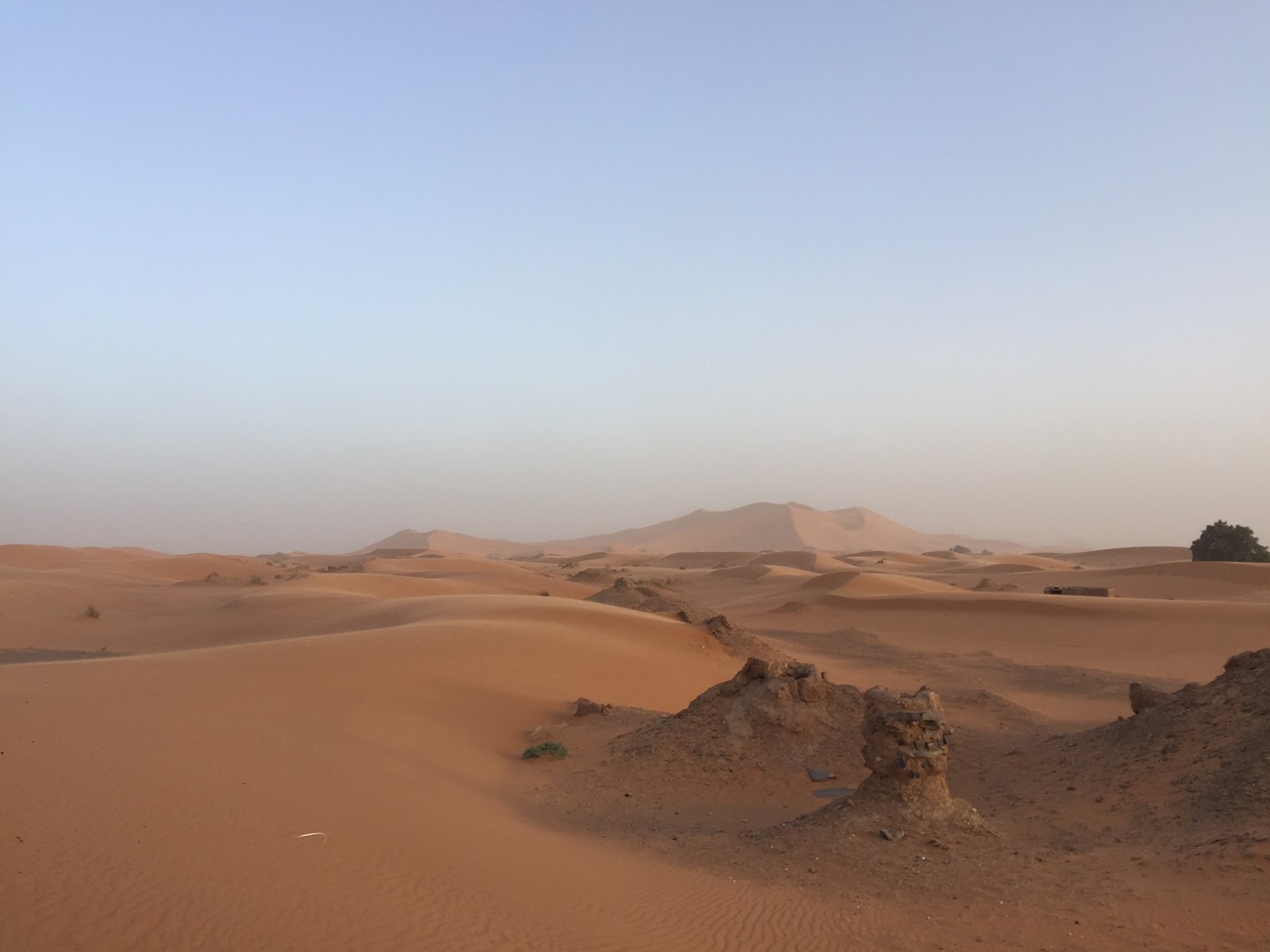
We awoke just before dawn, the point being to have dressed and waddled up a sand dune in time to witness the sun rising over the desert. Given that it’s dark before dawn, the fact that the power and the water weren’t working made things a bit tricky, but our flashlights saved the day. We gathered with our international cohort atop the nearest east-facing dune and welcomed the sun.

Or, at least, that’s how it was supposed to work. Omar hadn’t gotten the time right for the sunrise, so we missed the most dramatic colors but still got a beautiful view.

After a quick breakfast, we drove back to the building where we had first mounted our camels, this time in a truck driven by Omar. He seemed to think that the drive back should be as much of an adventure as the ride out, so he drove us straight down the steepest faces of the dunes, daring the truck to flip. At times, it seemed as though the front of the truck would drive straight into the ground, but somehow we made it unscathed. All the while, Moroccan hip hop was blasting, adding to the frenetic feel of the whole adventure. We actually loved the music, though, and used Shazam to record a few for later identification. During the less terrifying moments of the ride, we had breathtaking views of the desert and passed small raggedy tents (locals, perhaps? Or budget backpackers?) and camels grazing on the desert grass clumps.

We arrived back to Ahmed and Mohamed, whom we had missed very much. It seemed that Said, our camel guide, had been the one missing us, as he presented my mother, sister, and me with our own fossil-stone carvings with a sheepish grin. Then, it was to the car for another long day of driving out of the desert. It probably felt like a very long day to Ahmed and Mohamed, as my sister and I sang a smattering of hits from the 70s, 80s, 90s, and 2000s for the first hour of the drive. We discovered that Mohamed has quite the background in American music and is a big fan of AC/DC and Sting, so of course obliged with a few of those artists’ greatest hits. After we quieted down, we spent our time finding faces in the rocks of the mountains and learning about camels. These hardy creatures can carry 400 kg while walking on flat land and about 200 kg while wandering up and down dunes. They’ve also got great stamina, ranging up to 50 km/day walking or 150 km/day running. And as long as they’re not exerting themselves too much, they can go without water for 3 weeks. Very impressive!

We passed many towns that seemed half built or abandoned, but we were corrected: the half-built dwellings were ones that being built piece by piece when Moroccan workers in Europe returned home each year with new infusions of cash. The stretches of empty houses were the summer homes of city dwellers, often returning to their home towns. We were a bit confused why someone would want to come here in the summer, when highs reach ~54 degrees Celsius (~129 F), but Ahmed and Mohamed just shrugged and said that’s how it is.

We also made a few more photo stops at Ait Boujjan and the Toudgha Gorges.
A view of Ait Boujjan

Beautiful rock formations near Ait Boujjan

Toudgha Gorgeous, more like it
Can you spot the rock climbers in this picture?

How about now?

Our main stop of the day was at Maison de Cadeaux Berbere, or the House of Berber Gifts.
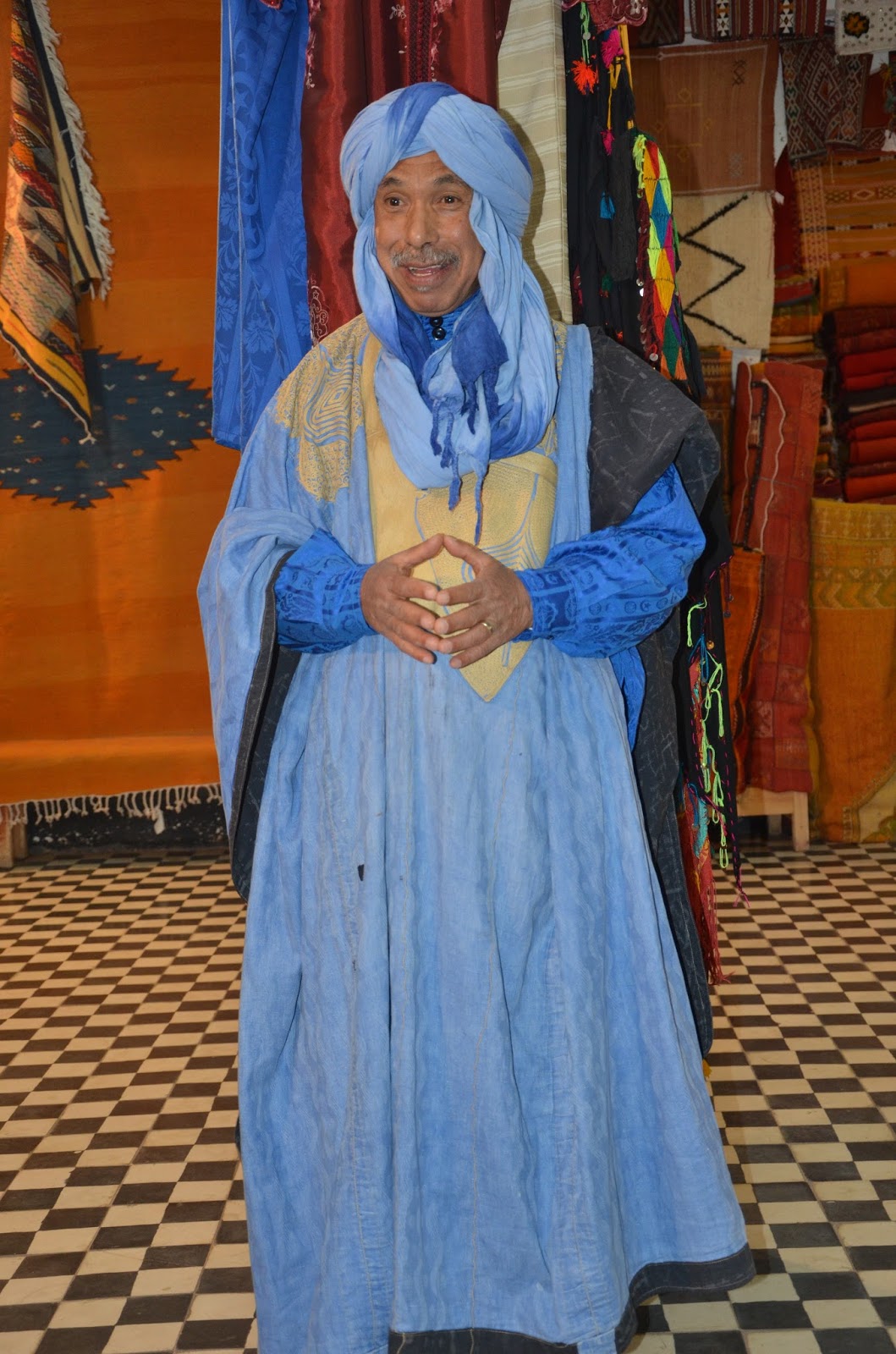
The proprietor, Ali, is a Tuareg Berber and was dressed in an elaborate blue outfit, as blue is the color of the Tuareg tribes.
We were first treated to a showing of a Tuareg suitcase made of camel leather and cedar tent stakes that looked like wooden swords, with mint tea to wash down our lesson in Berber culture.


Then came the carpets. Per both Ali and Ahmed, the Berbers do not typically make rugs for sale, but for family use. When a family member dies, someone divorces, or the family needs money, Ali will buy a carpet from them as a way to provide income in tough times. He has accumulated many, many carpets. We were shown the woven and embroidered rugs of agave silk, the knotted woolen rugs, and some carpets that used all three techniques: weaving, embroidery, and knotting. The designs were varied, colorful, and beautiful, often incorporating the “sacred eye” to watch over the owner. Many were reversible, with Ali joking that “the second side you get for free!”. We oohed and aahed over the colors, textures, and variety as the entire floor became covered in layer upon layer of fabric.

It felt weird to walk over potential purposes, but that’s the whole point of a rug. Ali wrangled my parents while his baby-faced, more timid brother, Al Mamoun, did his best to engage my sister and me.
Al Mamoun was not the charismatic born salesman that Ali was, but he was very kind and did his best to discover what colors and patterns we liked. A whole corner of the room was soon covered in blue carpets after I admired one. While the blue patterns were beautiful, I was truly coveting the thick, double-knotted Berber blankets that looked like they were made for naps. These, too, were reversible. One side was thick and cozy for winter, while the other was firm and flat, apparently for sitting on around a family tagine. After Ali’s sale to my parents went through, he came over to check how Al Mamoun was doing and, disappointed with his progress, led me back to the carpet pile to negotiate. Persistence is key in carpet sales, but also in maintaining a student budget, and we were well matched. I prevailed and managed to leave carpetless while still being polite. As we got back into the car, Ahmed told us more about Ali’s social work in the community, helping to support struggling families. Apparently, there is a day set aside for giving alms, and the line our Ali’s door rounds the entire block. Ali had seemed like a shrewd but kind man, and I was not surprised to hear he was such a pillar of his community. Honestly, I thought he seemed like he would be a very entertaining dinner guest.


We began to practice our Berber counting again and Ahmed told us we were now practically Berbers. He also told us a saying about Berbers, that they have deep pockets and short arms. Given that my brother used to talk about my sister's and my T-Rex arms, we thought that this was a perfect description for us. And given how few dirhams the average Moroccan makes, we are (relatively) rolling in cash... even though the salaries for animal trainers and (almost) residents are unimpressive by U.S. standards. Berbers it is.

We were in the home stretch of our day’s drive, and we again enjoyed incredible scenery. We stopped a few times in Dades, the “Valley of A Thousand Casbahs”, for pictures of the innumerable fortresses. Some, like Casbah Ait Arbi, were in mint condition.
Others were clearly ancient and their walls were crumbling. Per Ahmed, many of the older casbahs had been abandoned because they were incompatible with certain modern luxuries, like running water (it would damage the walls), and after being abandoned they quickly began to crumble.

After one last stop to document the incredibly windy road we took,
it was on to Chez Pierre, possibly our fanciest and most rural hotel. We settled in, enjoyed an amazing prix fixe 5-course French Moroccan dinner, navigated the maze to our room, and fell into a deep sleep in the silent desert.

Jam of the Day (thanks, Omar!): Aubameyang by Ghost ST ft. Soolking & DJa Chow - https://www.youtube.com/watch?v=ksrFuIY5m4k
[we have no idea what they’re saying, so apologies if it’s offensive]

Spotted: Salt and not-pepper shakers. As in the U.S., most restaurants provide two shakers full of seasoning on the table at meals. We have discovered, though, that their contents are different here. They still provide salt, but the second shaker is usually filled with cumin rather than black pepper.

Additional pictures from our day:
Our desert camp in daylight
This interesting rock formation has been described as looking like fingers, toes, or even monkeys

Friday, March 2, 2018

Million-Camel Baby

We awoke early, as we had a long day of driving ahead of us. Most importantly, though, it was my father’s birthday! We snuck down early to give the riad staff a candle to put in my dad’s breakfast corn cake. Alas, those were not yet prepared, so a single little candle came riding to the table atop a fresh orange. One “Happy birthday to you” rendition later, we were heading out to the car for the long ride to the desert.

Our first stop was in Ifrane, also known as Little Switzerland.
This town is up in the Atlas Mountains and gets snow, and its architecture boasts peaked roofs unlike the flat-topped dwellings in the rest of Morocco. We stopped for just a moment for a “comfort stop”, but we did make a point of checking out the giant lion sculpture.
The Ifrane lion sculpture, there to honor the last wild Atlas lion killed in the area, I believe by the French, in the early 1900s.
We continued on our way, noting the changes in the scenery outside. We saw snow and then melt, monkey crossing signs and then sandstorms. It was strange to watch the scenery, including the road in front of us, turn hazier and hazier.
Luckily, this was a light sand storm, so we never lost visibility to the point of being unsafe. Still, it was strange when the sand cleared and saw sand dunes and pale red rock faces to our left, while snowy peaks rose to our right. It felt like we were truly in the middle of nowhere.

We stopped for lunch named Midelt, or “ascent”, because it is on the steep climb up into the Atlas Mountains. The town is also famous for its apples; each year it hosts an apple festival where a “Miss Apple” is named. The lucky maiden is apparently chosen for her “apple-red cheeks”. The highlights of lunch were a rosemary-stuffed trout dish and having the guide for the group at the next table tell me that in these parts, men would trade a million camels for a woman like my mother. I told my mom that I, too, thought she was valuable, but that with some haggling I could increase the price by 50%. I later learned that someone had (jokingly) offered my dad some camels for my sister the previous day in the leather shop. It seems our popularity is growing. Little do they know we are very obstinate wives. They’re probably better off with the camels.

As we kept wending our way deeper and deeper into arid desert, we passed fewer and fewer houses.

At times, the only life in sight was a small band of 2-3 nomads crouched by the side of the road selling soda bottles filled with wild honey, their goats foraging what little grass grew from the rocky soil. Occasionally, the highway would pass a sign for a hotel, though it was hard to imagine they could drum up enough business this far from anything to do. The mountainsides were littered with rocks and steep enough to be treacherous, so hiking didn’t seem like a big draw. My favorite name was “Hotel Jurassic”. Speaking of ancient times, our last “comfort stop” of the day had fossils for sale.
The rocks here are rich in fossils, mostly trilobites and ammonites, with some fossilized coral. It also had incredible views of an oasis that had sprung up along a creek. There seemed to be an invisible dividing line between the lush green of bushes and trees and the peach-colored sand and rock.

At long last, we reached our desert destination. We disembarked from the car and… embarked on our camel adventure! We mounted our four furry beasts, with our baggage draped over the saddlehorn. The camels lurched to their feet, rocking back and forth several times before reaching the full, upright position. The camels were tied to one another and our guide, Said, began to lead them, still lurching, through the desert.


Let me tell you, camels do not offer a smooth ride. It is very different from riding a horse or even an elephant. But their surefooted lurching through the desert at sunset made for a beautiful ride. Plus, the lurching was dampened a bit once they reached the deeper sand. The wind whipped in all directions, blowing grit into our mouths as we practiced counting in Berber (Said was thoroughly entertained) and whistling as it passed through the straggly grass fronds that grew in small patches at the bases of some of the dunes. We could see the sand taking flight from the tips of dunes and marveled at the sharp edges in the sand created by the wind, as well as the lapping fronts of sand that looked like memories of waves on sand at the beach. We meandered around and over dunes, with the camels protesting when they thought the grade too steep. I got the grumpy camel, and he protested the whole way.  As the sun set behind us in a dusty haze, a full moon grew brighter ahead.
We could see a cluster of tourists at the top of a faraway dune, the bright burst of their camera flashes popping against the sky as they tried to capture the celestial changing of the guard.

At a point that looked no different than any other we had passed (at least to me), Said commanded the camels to kneel and we dismounted.
We trudged up a dune on foot, and our camp appeared in the valley below.
We had been told we were staying in a luxury camp, but we were still in for a surprise. Our tents have working electricity, including outlets and light switches, as well as en suite bathrooms with running water and flushing toilets. Honestly, the toilets here work better than any others we have in Morocco. We had packed every warmth layer we brought after watching the temperature plummet on the weather forecast, but our tents have sturdy sides and even space heaters.

At 8 o’clock sharp we reported for dinner in a larger tent. While the courses were bland, the company was not. The ringleader of the camp staff, Omar, was able to flit from table to table and greet each guest in their native language, including English, French, Italian, and Chinese. He spoke to our table mostly in Spanish, having heard from Ahmed that we spoke it. Omar was a chubby-cheeked late-20s guy with a mop of dark curls and a personality that took extroversion to new extremes. His energy, and the way that he punctuated every sentence with an “Afreeka!!!!!”, was infectious. Every table went from shellshocked to engaged in a matter of minutes. At the end of dinner, Omar brought out a cake for the birthday boy.

 We sang in Berber and then Arabic, greatly entertaining the staff (a running theme of our trip). Then, it was cake all around. The true entertainment, though, had yet to start. The staff - Omar, bubbly boy-faced identical twins named Walid and Jalid, and a sparsely-toothed older man who remained quiet – sat with drums and castanets and began to play and tell jokes. They invited the guests to come and play the drums, but only our family took them up on the offer (shocker). I think my mom and I did pretty well! Walid and Jalid certainly seemed impressed.

The evening complete, we retired to our tents, climbed into unbelievably comfortable beds, and slept deeply.

Spotted: the royal family. They’re everywhere! Many shops have a picture of the king, queen, both, or the entire royal family framed inside or even on display in the store windows.

Additional pictures from the day:


See the camel caravan in the distance? (click the picture to see a larger image)


Thursday, March 1, 2018

Rockstars in Paradise

Well, I can now tell you from experience that waking up in a palace is just as exciting as going to sleep in one. This place is beautiful. Every inch of Riad Myra is decorated with beautiful tiles, ornate plasterwork, intricate wood carvings, or embroidered fabric. Leaving the hotel for the medina was no less magical, as we walked past walls dating as far back as the 11th century. We met up with Mohamed, who drove us to the top of the city to the south bastion for panoramic views of new Fez and old Fez.

Modern day Fez is huge, housing about 1 million people. As I mentioned yesterday, many of those people are master craftsman, and today was our day to learn about their trades. We first headed to Mosaique et Poterie de Fes, where we learned how the beautiful Moroccan pottery and tile mosaics are made. First, we had to ooh and aah over the lumps of gray clay (the finest, we are told, much better than that red clay), 

but then we got to see people actually working with it. They were incredible, one molding identically-sized bowls by the dozen in minutes and the other shaping fancier pieces (candlesticks, decorative bowls with wavy edges, etc) at a steady clip. 


My sister, our family artist-in-residence, stepped up to the wheel and managed to mold a plate on her first try. 
Sure, it might wobble and was certainly thrown back on the clay pile after we left, but it was far better than I could have managed. Neither of us would be eligible for employment here, as a typical worker has to make 800 tiles a day, which only takes them about 6 hours. I imagine, from the pace of bowl making we observed, that you’d have to make nearly as many of most other items to earn your keep.

We next saw the earthen kilns where the pottery is baked. Olive pits are added to the fire, and the color of the flame helps them regulate the temperature to a cool 1200 degrees. 
Then, it was on to how this beautiful clay can be decorated. We started with a style that I hadn’t seen (or at least noticed) before where some of the glaze is carefully removed to create patterns. 
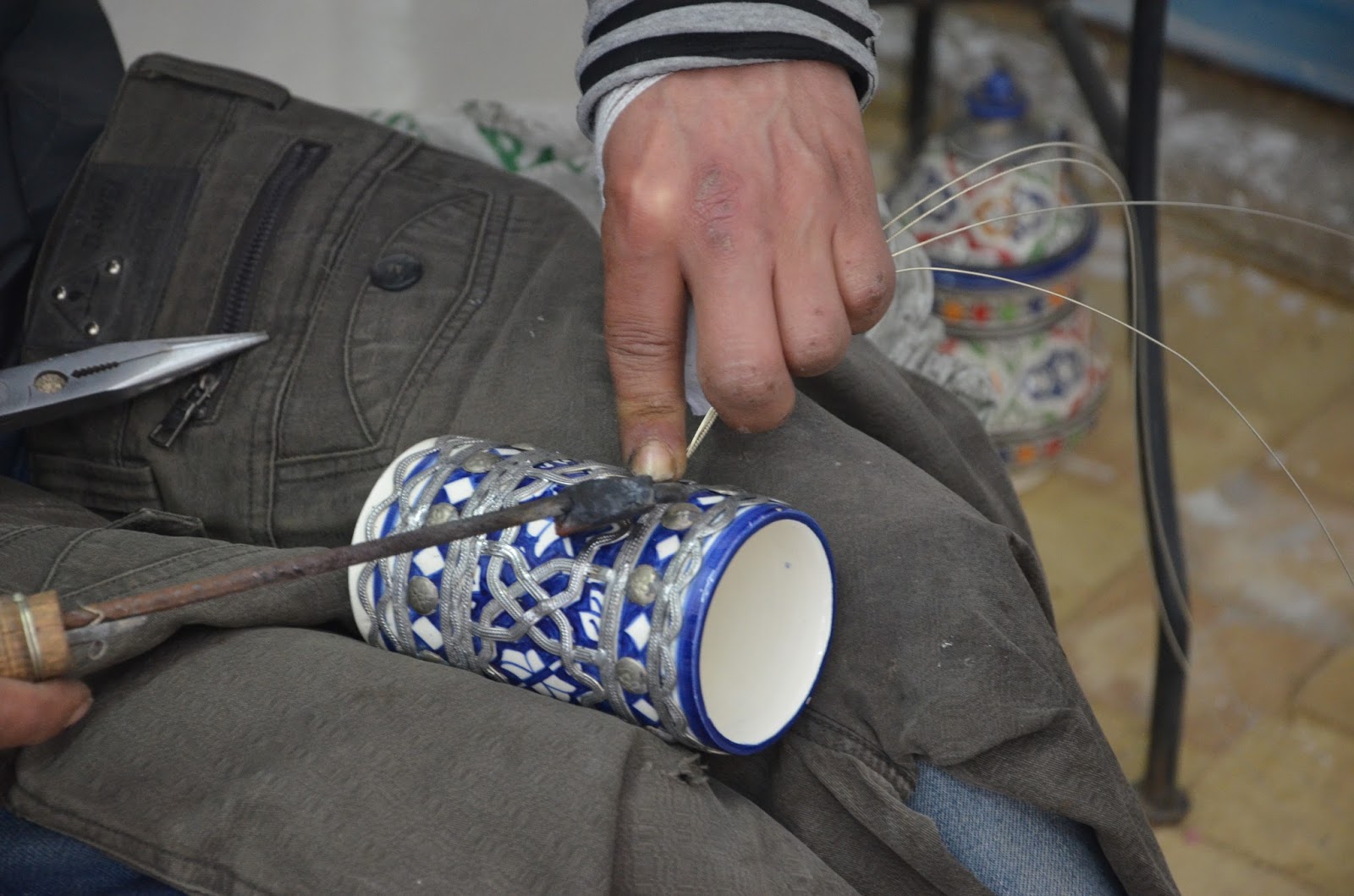
Next, we saw craftsmen soddering silver wire onto bowls as decoration, chipping square tiles into smaller shapes to fit into mosaics (they have to sharpen their adzes every two hours!), or painting designs on to bowls with natural dyes. Fun fact – cobalt dye looks purple initially but becomes a dark blue after the piece is fired in the kiln.


Next, we saw them actually making the mosaics from the small tile pieces. They place everything upside down (so you better be careful about your colors), cover it with several layers of cement, and then flip it over to finish the piece. 
The tables and fountains that result end up weighing much less than you’d expect, and the patterns are mesmerizing. Wandering the store afterwards, surrounded by thousands of pieces, was a lesson in the variety of patterns and styles possible with these techniques.


While that might seem like enough for the day, we did squeeze in several more stops. We went to a palace from the 14th century erected for the Alouet dynasty and recently restored by Hasan II (the current king’s father). 
We went to a madrasa (basically a large square enclosed by walls) that was elaborately decorated. 
It’s also the only madrasa with its own minaret, because it’s the only madrasa with its own mosque. The building used to be used as a school, with students residing in the dorms surrounding the square, but the French government put a stop to that because they felt that too many anti-French ideas were arising from educated locals congregating in such a place. Interestingly, the madrasa is decorated with a good deal of marble, as the Moroccans used to trade Moroccan sugar for Italian marble, pound for pound.

We then stopped for lunch, which deserves its own shout-out because it was AMAZING. We were at Restaurant Nejjarine (nejjarine means carpenter, as we were in the woodworking distict), and everything was delicious. They also served us the (cooked) salad course to end all salad courses. Definitely stop by if you’re in Fez!

Our final stop was at the tanneries, which have been running continuous since the 14th century and employ over 950 families. 
The tanneries have also been stinking up a good deal of the medina all those years, as the traditional leatherworking process uses the mix of pigeon droppings (acidic) and lime and to soften and bleach the leather. Knowing the stench might come as a surprise, they supplied us with mint to sniff. 
After bleaching and softening, the hides are dyed with natural pigments (red from poppy, orange from henna, yellow from saffron, brown from cedar, blue from cobalt, etc). the hides sit in the vats for at least 20 days and must be moved around every 8 hours. 
Dyed hides are used for different things based on the type of animal. Camel hide is lightweight but strong and is often used for bags or belts. Cow leather is strong and heavy, and is used for similar items. Goat leather is light and very, very soft. It is therefore used for the wearable items, like jackets and gloves. We toured their shop, which was filled with lightweight camel bags, deliciously soft goat skin jackets in every color, and very eager salesmen. 
My sister and parents each ended up getting jackets, and then they made me haggle for them. Now I look like the schlubby photographer trailing a band of rockstars.

We ended our day with dinner at Café Clock, a restaurant attracting an eclectic bunch of diners, from tourists eager to try local cuisine and henna workshops to locals who enjoy the Wednesday night jam sessions and belt out pop songs from around the world, boy band-style. We managed to enjoy a few new drinks, including date milkshakes, fresh mint lemonade, and banana lassis. Then, we stumbled home for a good nights rest. It takes a lot of energy to soak up Fez in just two days.

The other thing I learned? I would never make it as a craftsman. Good thing I’m traveling with rockstars.

Spotted: some serious bling. Women here often have bedazzled belts to wear over their clothes on fancy occasions. The affordable version is made from dyed agave silk, which glistens like metal threads. The more expensive version is a giant gold belt that makes it look like you won the big WWE fight.


Additional photos from our day:
A beautiful tile mosaic table

Wood scaffolding holding up the creaky, sagging walls of the medina. Many families are too poor to restore their old houses, so the government puts up scaffolding in the meantime. Really makes you feel safe walking beneath it.

A metalworker free-handing an intricate design with just a bit and a hammer

Weaving a blanket using a shuttlecock that shoots back and forth

My sister and I wearing our new djellabas in the leather store. Djellabas are also known as "Moroccan sleeping sacks", and we're excited to use ours in the desert

Learning to tie turbans in preparation for the sandy desert. We did pretty well!