Tuesday, October 8, 2019

With an Arch Smile


Today was all about the arches. Arch mania, one might say. We started with Delicate Arch, which has become a symbol of Utah and ornaments the Utah license plate (so we had seen it a lot before today). 
It’s the largest free-standing arch in the park and is worth all of the gently-sloping-hope-I-don’t-slip terrain you traverse to get there. Apparently, it has had more colorful names in the past, including Cowboy’s Chaps, Old Maid’s Bloomers, and Salt Wash Arch. In 1934, an article described it as “the most delicately chiseled arch in the entire area” (more on that later) and the arch was born again.
For scale, see the tiny humans
After Delicate Arch, we headed to the area by Devil’s Garden Campground to see the Sand Dune Arch and Broken Arch. Sand Dune Arch is nestled in the narrow opening between two tall sandstone fins. 
Gigantic entrance slabs
Sand Dune Arch
We learned from the handy signs at the trailhead that these narrow fins of stone are the result of inflexible stone breaking as the huge piles of salt beneath it bulge upward. 
The Salt Valley between fins of stone represent places that the underlying salt dissolved when water seeped in, causing overlying rock to crash down and then be worn smooth. 
The colorful Salt Valley
Neither Josh nor I have any real idea how this was figured out, but a big shout out to the geologists that make this knowledge possible. After Sand Dune Arch, we meandered over to Broken Arch. 
The first thing that everyone likes to point out about Broken Arch is that it isn’t really broken. There is a crack along one edge, but the arch looks mighty stable and there’s no gap. While admiring this beauty, Josh and I met an adorable elderly couple from Colorado who added additional items to our Future Vacation To See List and showed us exactly who we want to be in another 50 years.

Last but not least, Josh and I hiked out to Landscape Arch. 
According to park signage, Landscape Arch is the 3rd largest natural arch in the world, although the Natural Arch and Bridge Society (NABS) begs to differ. But who really cares? It’s really big and really impressive. My biggest issue with the whole thing was that Landscape Arch seems much more delicate than Delicate Arch. Of course, Landscape Arch lost some serious weight in the mid-‘90s when a few large rockfalls slimmed down its silhouette and forced the National Park Service to close the train beneath it. Pictures from a better angle really drive home how thin the Landscape Arch has become.

Well, is Arches National Park on your Travel To See List yet? If you still need more convincing (seriously?), stay tuned for one last Arches adventure tomorrow.

Spotted: Ravens! Our hometown birds are all over the place, looking all regal and fierce. As Josh and I realized after a recent trip to the zoo (beyond that the Baltimore Ravens do sponsor the Maryland Zoo ravens), ravens are pretty big, magnificent birds.


And one more pic just because:

Car Appreciation Day

Warning: gratuitous use of photos ahead.

We left Denver, realized just how big the state of Colorado is, and were completely dumbstruck by the beauty (and variety) of the landscape unfolding before us. There were molded hills of smooth stone, jagged cuts through rock exposing every layer - red, tan, brown. And even within those colors, you saw the entire rainbow as you got close enough – red bushes, green shrubs, yellow grasses, blue hints in the stone face. For a long while, the highway followed the river as it wound through a cut between the cliff faces. We couldn’t help but think about the importance of mountain passes back in the day (mostly in the context of elementary school Oregon Trail games, if we're being honest). The cliffs would have been daunting (but really impossible) in a wagon. As we crossed each mountain line, we noticed another thing that hasn’t changed – each valley offered a sudden flourish of buildings, like an outpost town, ready to supply you with provisions, hardware, and a place to rest, while between them lay long stretches of raw, rocky land. Who owns all those open square miles? Another fun sighting was the "2 Kool 4 Skool" bus, which we had seen the day before parked outside Rocky Mountain National Park. We looked it up, and it turns out it's a school bus converted over the past year by a family with some serious wanderlust. 
Can you spot our pika friend enjoying the view?
A few hours and hundred miles later, we settled into our new lodging in Moab, Utah and set out to explore the small town. To say the town is geared toward tourism is an understatement, as the annual number of visitors has climbed to 3 million and the number of tourist lodgings has increased by more than 50% in the last 5 years. This, of course, is largely driven by the visitors to Arches National Park and Canyonlands National Park.
Begrudging husband is begrudging
Interestingly enough, though, it’s also a college town, home of Utah State University Moab. College in Moab would have been a very different experience than the one I had in a New England college town-city hybrid – one spent breathing in the outdoors, perfecting mountain biking skills, and studying in the reflection of the red rocks. Which leads me to our next realization: though Josh and I plan to hike here, it seems that the cool thing to do is mountain bike. As we meandered through the small downtown and stopped for a bite to eat (at the one and only Quesadilla Mobilla), all of the buzz at surrounding tables was about wheels and miles and bike trails. Guess that's on the agenda for our next trip out here (with every place we stop, our future trip to do list grows longer).

Still, there’s plenty for the hikers. In the evening, we headed to Arches National Park to take in a couple of the more accessible viewpoints and catch the sunset. Driving into the park makes you feel like you can’t look enough directions at once. There’s too much to see, too much to miss. Eroding columns of rock look like animals, faces, or monuments depending on the angle and the lighting. We passed Park Avenue, La Sal Mountains, Courthouse Towers, and so many more whose whimsical names didn't make the map.


We stopped at Balanced Rock, a piece of stone that weighs as much as 1,300 cars and sits nearly as tall as the Statue of Liberty. Formed from harder stone sitting atop an eroding layer of mudstone, Balanced Rock is doomed. 
Its smaller sidekick (the aptly named Chip off the Old Block) toppled 40 years ago and Balanced Rock's own clock has been ticking ever since. From there, we headed to The Windows, hiking the “primitive trail” around its periphery. We saw Turret Arch glowing in the light of sunset and settled in to watch our burning star fall below the horizon.
The North and South Windows
Stranger standing in Turret Arch

Of course, when we got home and met the father and son sharing our AirBnB, they told us they biked “the whole enchilada” – which turns out to be a trail called The Whole Enchilada.

Spotted: Runaway truck ramps. During a seven-mile stretch of seven-degree downhill, the highway shoulder was punctuated with regular runaway truck ramps. If your brakes overheat or fail, you pull onto the steep upward ramp until all of your kinetic energy becomes potential energy… and you can finally stop panicking. 

Monday, October 7, 2019

Give Me Shelter


Well, our long-awaited vacation has finally arrived, and we are thrilled to have escaped to the West. We landed in Denver on Saturday evening, enjoyed a stroll around Larimer Square (cute but smaller than expected), bought an enormous amount of provisions, and settled down for a good night’s rest before our first big day. Our first impression of Denver is mostly a shock at how new everything is. Around Larimer Square is a small cluster of older buildings, including one labelled “1886”, as well as some single-story brick shops that now look oddly out of place, as they are just down the road from towering skyscrapers and the enormous modern performing arts center with its sky-high dancers caught mid-twirl. We had heard there was a lovely river wending its way through the city, flanked by strolling paths. River is perhaps a generous term for this small body of water, which appears to be only a couple of feet deep at the heart of urban density, but it is nevertheless a nice touch by the urban planners, and appears to have art dotted along the banks. In short, it seems like a city that is still figuring itself out, even though it is off to a good start.

Sunday morning, we arose before dawn to pack our car and hit the road to Rocky Mountain National Park. A two-hour drive from downtown Denver, this enormous park has so many miles of trails it seemingly must have something for everyone. The drive out of Denver is striking for multiple reasons – the rapidity with which the city falls away and flat endless fields spread out before you, and the suddenness of the mountains’ rise in the distance, dappled with light and almost scraping the clouds. At long last, we were driving up those mountains and into the town of Estes, where we had a chance encounter with a whole herd of elk perched on a grassy median in the center of town. Funnily enough, that median boasted several metal statues of elk, leading Josh and me to joke that this was an elk tour group told to meet at the statues at 9 am for an early start. 
A police car was parked next to this median the whole time to prevent curious onlookers from getting too close.
As we drove on, we passed the camp grounds, where huddled campers were thawing the chill in their bones with hot cups of morning brew, cut the long line of cars with our America the Beautiful Pass, and nabbed one of the last parking spots at the Bear Lake Park and Ride. Pro tip: Rocky Mountain hikers do not mess around. Arrive early, pack lots of snacks and water, and dress in lots of layers. Bonus points if you bring along a really funny hiking partner who tracks how far you’ve gone on his GPS watch.

Josh and I had decided to hike from Bear Lake (a mere 0.5 flat miles from the trailhead and therefore popular with the families-of-kids-under-5 crowd) to the peak of Flattop Mountain. This 4.4-mile hike (each way) was marked as “strenuous” due to its 2,849-foot elevation gain, while already at altitude. But what could two relatively fit, able-bodied adults have to worry about? We hiked the first several miles through rigidly upright evergreens that towered overhead, with a soft, well-kept path underfoot.
As we gained elevation, the height of the trees and the temperature both began to drop. Outlooks rewarded our efforts with sweeping views of the valley below, dotted with iridescent blue lakes.
Then we hit the tree line, and everything changed. Rough shrubs bordered the increasingly rocky trail, and the wind picked up with a vengeance. We quickly put on every layer we had – beanies, gloves, jackets, more jackets – and pushed on. People we passed, who had previously been sunning themselves on large rocks, were now taking shelter beneath small slabs of rock to wolf down snacks. We repeatedly heard a piercing cry, which at first we attributed to some hidden nearby bird nest but discovered was from the tiny, furry pikas who scurried over the rocks.
These little guys collect bits of grass and greenery and bury them to find during the long winter, kind of like squirrels and their acorns. After what felt like quite a long time, we approached the summit. By this point, my fingers were numb and my face raw from the wind. We summitted, snapped a few pictures, and hurried back down.
Luckily, descending is much quicker than ascending (about 1.5 times as fast, per Josh’s watch). We didn’t stop until we reached the shelter of the trees again. As we continued to descend, we started to remember what it felt like to sweat – to have a high enough core temperature to sweat – and my fingers swelled as the blood flow returned. Once we reached the bottom, we wandered around Bear Lake, found a sun-soaked rock, and hunkered down to devour our remaining snacks.
Perhaps we hadn’t taken the “strenuous” hike rating seriously at the beginning, but we were now humbled and exhausted.

Before heading back to Denver, we browsed the storefronts of Estes, half of which seemed to be advertising sweet confections. Josh and I, predictably, were drawn to the paintings, glass art, and stonework. One store had some large fish and manta ray fossils that were estimated at 50 million years old, a number that stops you in your tracks. As we wandered around that store, I was amazed by how many of the fossils and rocks came from the local mountains, a hint at the beauty lying beneath their trail-worn surfaces.

When we finally got back to Denver, we all but collapsed into bed. Insomniacs, Flattop Mountain might just be the medicine you’ve been looking for.

Spotted: So many things. Oil rigs rolling up and down by the side of the highway. A strangely high number of people walking recklessly across highways and dark streets – often slowing down to taunt you in the process. Weed shops everywhere with names ranging from the chill (Da Bong) to the “healthy alternative” (High-Level Health) to the acknowledgement of their rural location (Tumbleweed). Strangely, we haven’t smelled that much weed, but it is clearly a big part of Denver culture (and might account for the people aimlessly wandering across highways – see above).


A few bonus pics:
Josh is not a hunchback, he just stores things in the hood of one of his layers (something I discovered on this trip)


Friday, March 9, 2018

An Ode to Ahmed

Our last day was a bit of a choose-you-own-adventure kind of day, with no scheduled activities besides lunch. I spent the morning wandering through Essaouira with my father, letting myself get lost in Morocco one last time. Today's adventures will be told through photographs.

A skirmish at the morning fish market


My father and I were not the only ones watching the fishermen haul in their morning catch


The littlest helper

Who knew sugar had so many virtues? It apparently cures depression and slims your figure, among other things.

Not your average run on the beach


Kite surfing - the one thing we didn't manage to fit into our trip


Fishmongers try to woo you into purchasing their wares, which they will cook for you on the spot. One had a small shark strung up, while others had live crabs clacking around.
Spotted: the best guide ever! This photo is not from today, but it is one of the few that I have of our fearless leader (and Experience Morocco guide), Ahmed Mha. Ahmed was endlessly patient, knowledgeable, and kind. He was as quick to help a stranger in need as to crack a joke. We had a fantastic two weeks with him and I can't recommend him enough. Ahmed, if you're reading this - libitibito!
Who else could pull off the double hat look this well?

Trading Storks for Seagulls

First, let me wish everyone a (belated) happy International Women's Day!

It was hard to tear us away from Richard Branson’s fancy-pants hotel this morning, but somehow we managed to clamber into the car on time to head to Essaouira.


Along the way, we passed through the so-called Argan Forest, a swath of land that is home to about 20 million argan trees that supply the argan oil trade. Apparently, Morocco shares the argan tree with Mexico (similar to how they share the agave plant) because of similar climates and the way the countries used to fit together as part of Pangea. The argan fruits are harvested once a year during the summer and the oil is sold, well, everywhere all year round. Some tips from our fountain of knowledge, Ahmed, on how to make sure your argan oil is the real stuff: it shouldn’t remain greasy after it is applied, and it should freeze like butter if you put it in your freezer.

As we drove through the forest, we saw the goats climbing the trees to eat the argan fruit (perhaps with some encouragement from their herders, who charge for photographs - don't worry, we haggled).


We then continued on to a feminine cooperative that makes argan oil. 
A sea of argan nut shells in front of the argan oil cooperative
Creating these cooperatives was part of a sweeping government plan to make living in rural areas more desirable so that people didn’t move to the cities and create slums. It felt appropriate to visit on a day that celebrates women around the world. One of the women walked us through how the fruits are dried and then peeled, cracked (to get at the small argan nut inside of the larger husk), and either roasted to produce oil for eating or cold pressed to produce oil for cosmetics. 
Step 1: de-fruit the husk

Step 2: hammer the little argan nuts out of their acorn-like husk

Step 3: grind it all up!
The nuts are ground up in a traditional way between two stones and mineral water is added to separate the oil from the paste. We got to sample the roasted nut oil, argan honey, and a substance called amlou that is a combination of ground roasted almonds, honey, and argan oil.

We continued on to Essaouira, a beach town that was also known as Mogador (from the Berber word for “windy”). 
Essaouira was the capital of Morocco in the 18th century and, before that, was a major production site for blue dye for the Romans (resulting in the so-called Purple Islands off shore). It has had multiple incarnations since, including as a hippie hangout in the 1960s and 1970s that spawned the gnawa music style that is still celebrated annually at a festival in June. Throughout the centuries, Essaouira has remained a bustling port and a relaxing beach town, now enjoyed by both locals, traveling Moroccans, and international tourists alike.

The major crafts practiced in Essaouira are silver work and wood carving, and of course we wanted to see both. We started at the Centre de la Bijouterie Artisanale Maalem Ali, a silver workshop and store. We learned about the three styles of silver work: filigree, enamel (the traditional Berber style), and engraving. 
Bracelets with silver filigree
Apprentices in this craft spend three years learning the three styles. We saw six or seven students practicing in the workshop, many of whom appeared to be blind. They were thrilled when they discovered my sister could communicate a little bit in sign language, though there was only moderate overlap between American Sign Language and the local dialect.

We continued our walk, meandering down alleyways where sea mists had worn the paint off of walls and curled the edges of posters and pictures. 
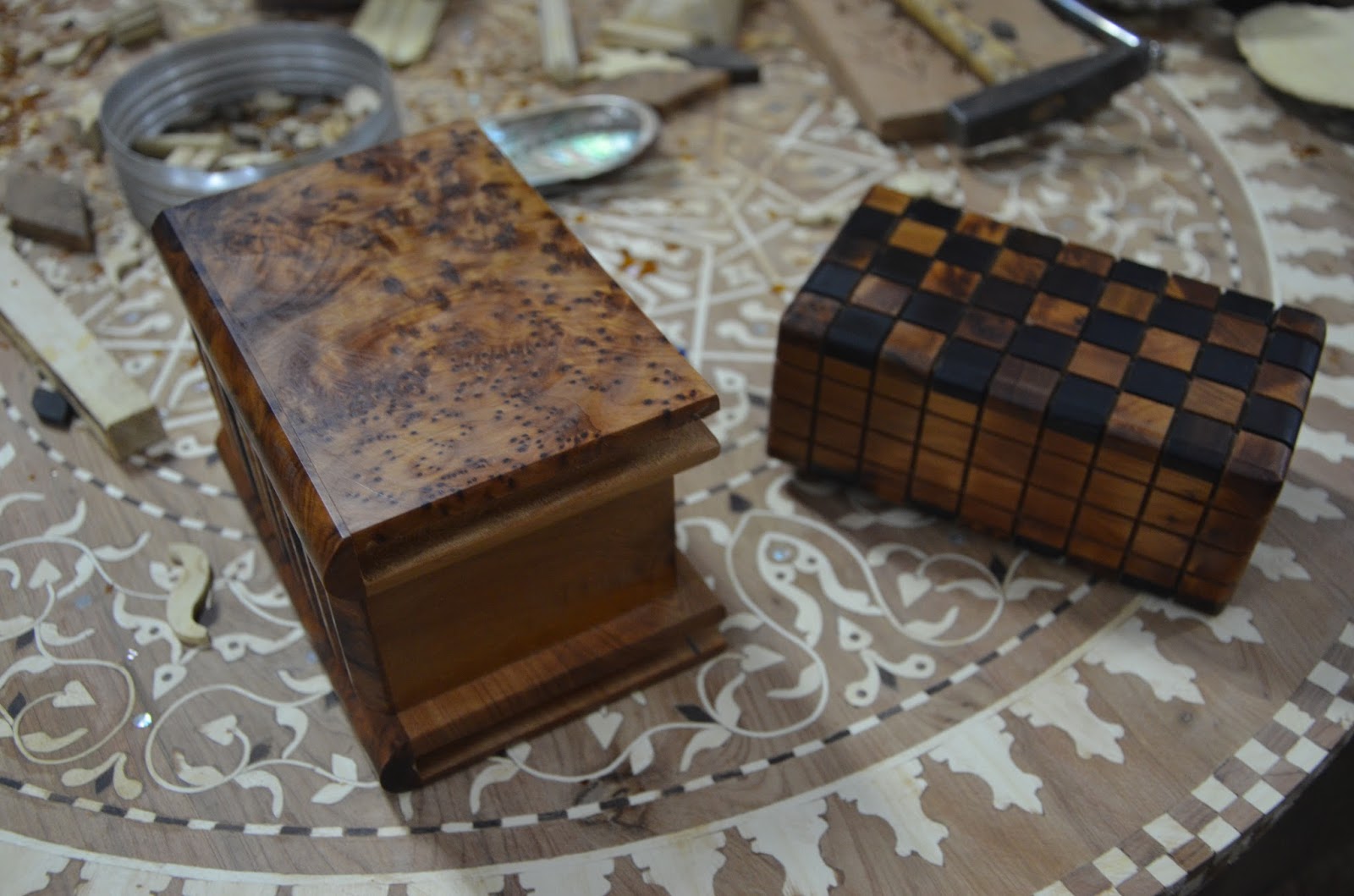
Big walls lined the city, interrupted by slits for archers or cannons. A few more turns and we arrived at Centre Artisanal d'Essaouira, a workshop for wood craftsmen. The salesman showed us the different colors of the different woods (lemon is light, acacia is dark) and the difference between wood that came from the trunk versus the root (more burled). 
He also showed us the difference between inlay and overlay and how the different pieces are sized and sealed in place. We also got to play with the Moroccan “magic boxes”, which have several hidden pieces that slide out to reveal first a key and then, with another few deft moves, a keyhole. 
The salesman initially said if we opened it successfully we could have it for free, but soon regretted that promise when he saw what good puzzle-solvers we were and started setting time limits to make sure we couldn’t win. The workshop and adjoining store had a wealth of incredible pieces, reminding me yet again how much I love woodwork.

A piece in progress from the workshop

This little box had a surprise inside when you opened it
The rest of the evening was spent walking back through our hotel through the narrow labyrinth of the medina that we have come to know and love in old Moroccan cities. We ended with our farewell dinner at a restaurant that, strangely, forbids guides from dining with their clients. Good thing we’re good at entertaining ourselves! We were sad, though, not to have Ahmed’s company.

Spotted:

Additional photos from our day:
And the World's Most Photogenic Father Award goes to...


Necklaces, including traditional Berber jewelry (center) at the silver shop

Traditional blue wooden boats used by Essaouira fishermen


Casually walking with a squid in each hand

Essaouira street art
Cats are everywhere! In Islam, they are creatures not to be harmed, and many people feed them, scratch them, and otherwise take care of them. As a result, hundreds if not thousands of cats roam the streets of every city.

A beautiful Moroccan metal lamp

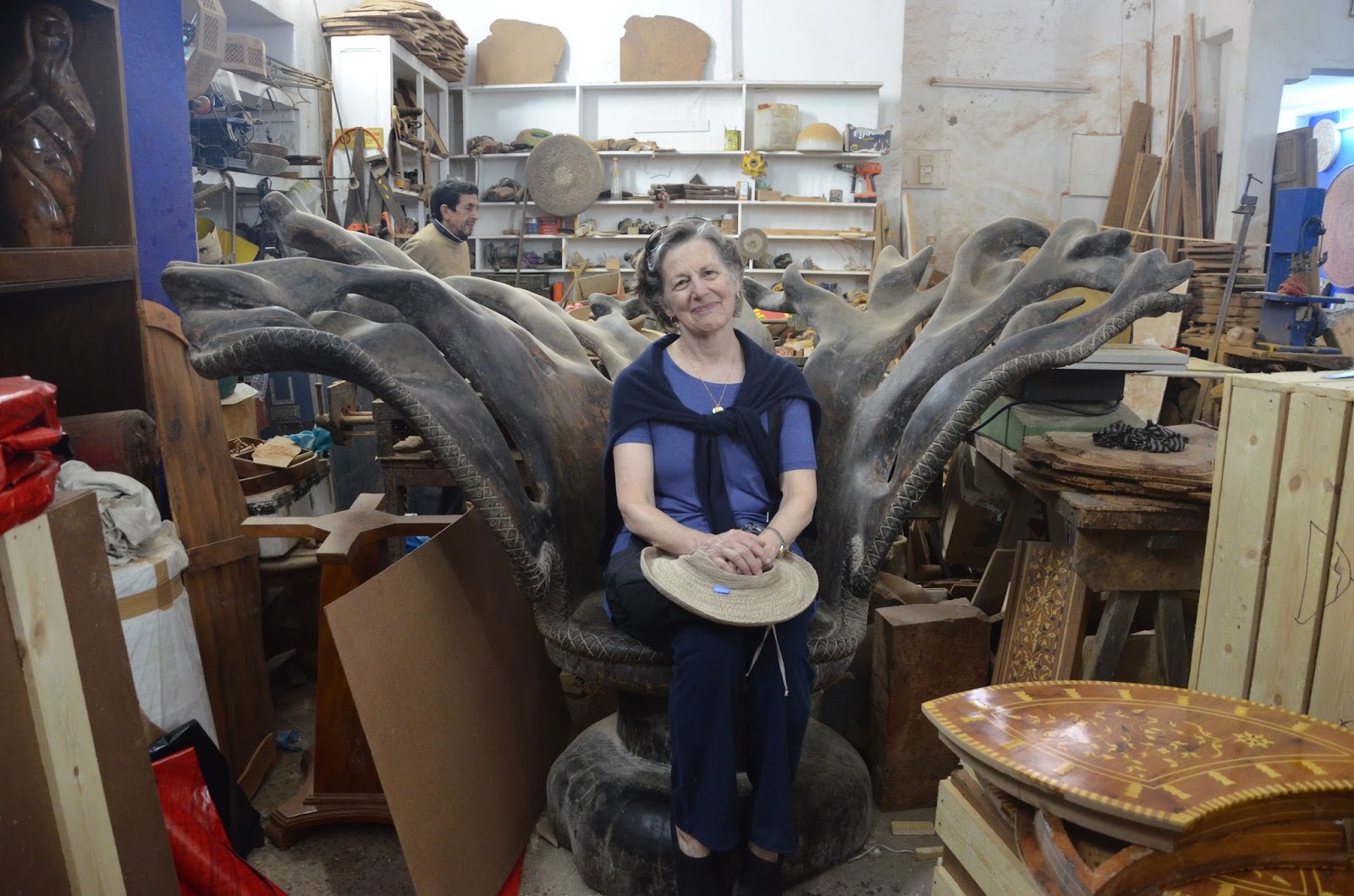
Our Bahia on her throne