Monday, May 23, 2022

Red-faced


We awoke in a cocoon of blankets in our tipi and emerged into a frosty wonderland, with a chill in the air and a clear snowline demarcated on the mountains. 


Yellowstone used to lie under 4,000 feet of ice, and we’re grateful that’s no longer the case. That would have necessitated much more than a couple of thin layers and a hat. But we did learn that you can ski here during nearly every month of the year. The rain showers we endured yesterday resulted in two feet of snowfall on some of the taller peaks in the park. 

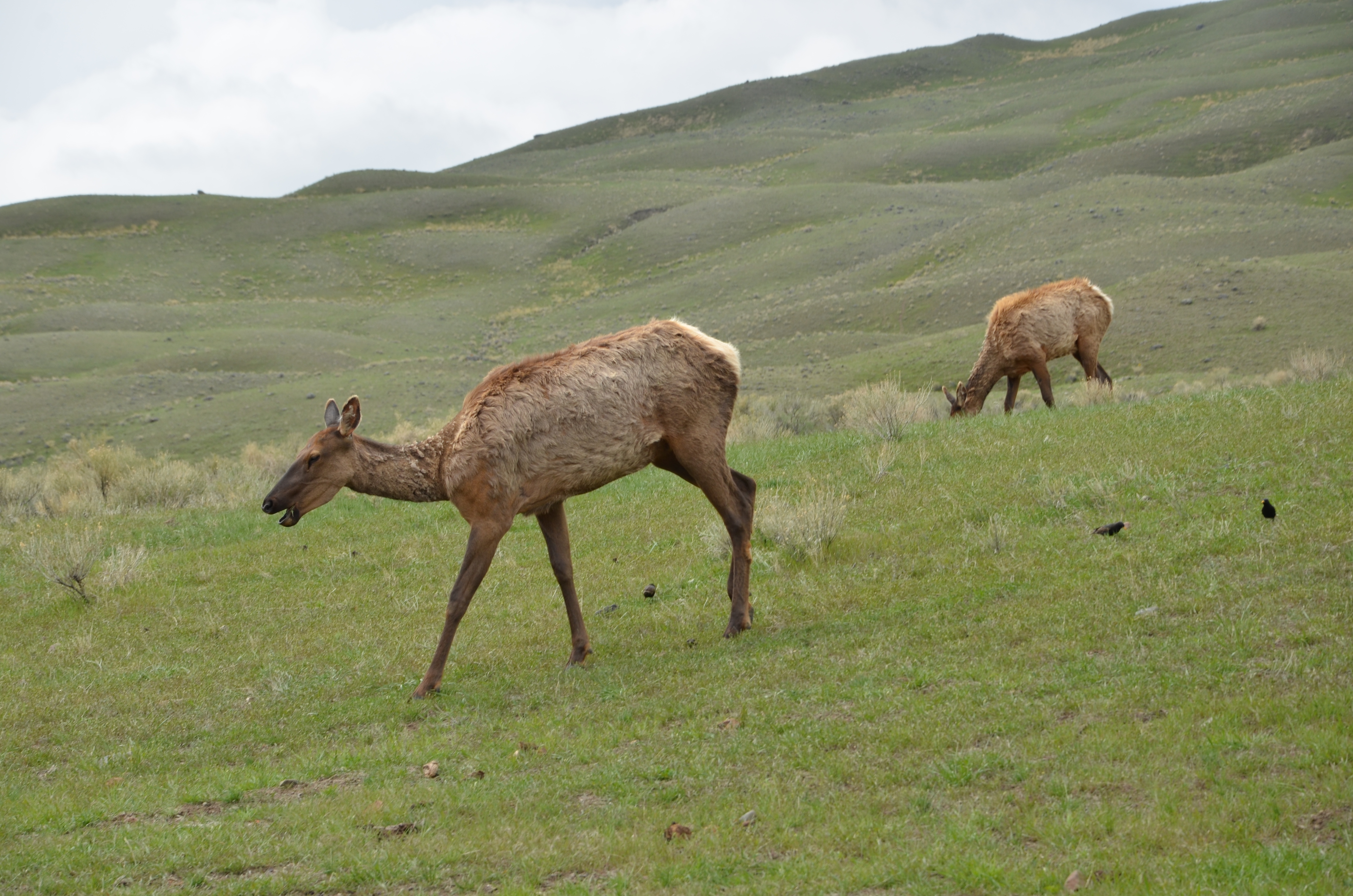
After a hearty breakfast, we all hopped in the van for a day of eagle-eyed wildlife spotting. Of course, many of the wildlife are abundant. Elk lounged in nearly everyone’s yards and bison were – well, we saw plenty of bison. And that’s a great thing. The bison population dipped as low as about 20 at one point, but through conservation efforts has rebounded to about 6,000 in Yellowstone National Park (with another few thousand around the country).

So, yes, we saw a lot of bison. And we learned a lot about them. The first herd we came across was females and calves. 


The females each weigh in between 1200 and 1500 pounds, while males can weigh around 2000. Males are seen in small bunches (for young bachelors) or alone (for older males). The females stick together. Overall, they have a matriarchal society, can run about 30 mph, and can clear fences despite their size. 

Still, they’re not always agile. They have to rock back and forth several times to get up from the ground (which we got to witness) and they can’t roll all the way over when they wallow because of their humps. Their wallow spots are muddy pits dotting the otherwise green landscape, and they also kick up dust for dust baths. Other key tip: when they have their tail up, they’re getting ready to poop or to charge you. As our guide likes to say, they’re getting ready to charge or discharge.


Our next stop was to see one of Yellowstone’s petrified trees. There used to be four standing together here, but the others were chipped away at to create souvenirs. The late one at this site now stands behind a fence. Petrified trees such as these can be millions of years old and form when silica slowly replaces the tree matter. There are apparently a bunch of other petrified trees on Specimen Ridge, which we sadly didn’t get to see. 

We continued to drive through the park, venturing from Blacktail Plateau into the Lamar Valley as we continued to seek wildlife. Orange-tinged willow bushes bordered the Pelican River (yes, white pelicans flock here in the summer), which wound beside the road. As the morning fog burned off, the tips of the snow-capped mountains came into view and were breathtaking. We passed other rocky monuments, including Soda Butte, a formation of travertine that no longer spouts steam but does leak stinky sulfur gas.

The most breathtaking scene, however, was the wildlife. We watched a coyote pick its way through the sage bush 30 feet above a bison herd. (Can you spot the coyote in the photo? It was incredibly well camouflaged). 

We also saw two black bears – one a brownish color and one a cinnamon color – foraging for plants by the side of the road.


Apparently, they’re big fans of glacier lilies. Finally, we saw a huge crowd of cars pulled over and learned there was a grizzly bear tearing into a carcass. Ravens swirled overhead and hopped close to the bear, only to have it charge and force them to fly off every 10 minutes or so. The bear was just close enough to be seen clearly through our binoculars. We watched it flip over the carcass several times, and several times it raised its bloody face to stare at the assembled crowd (zoom in on the dark spot to appreciate the red face).

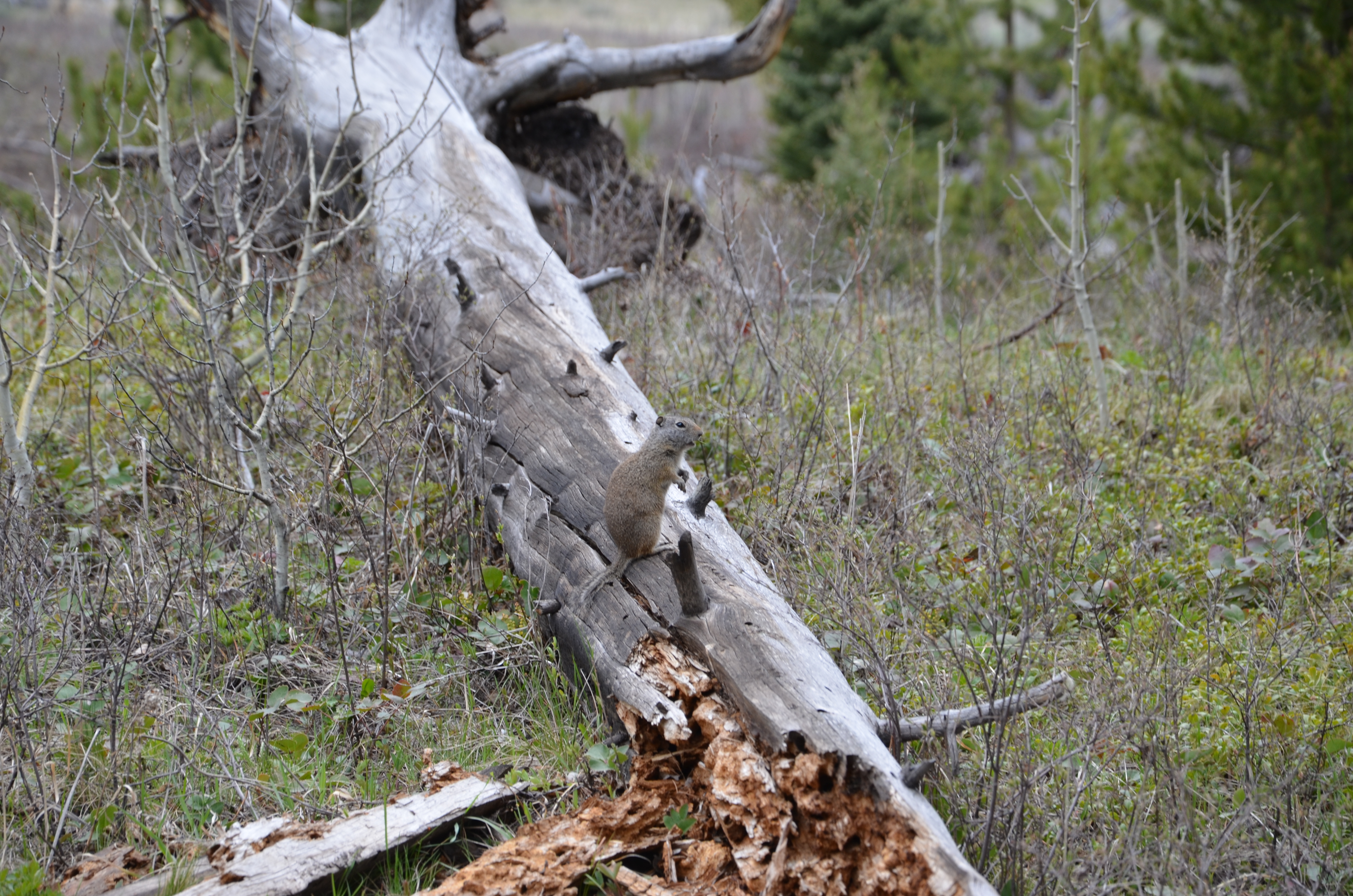
Finally, we went on a few short hikes. These brought more wildlife sightings, including a marmot who was incredibly expressive and also showed us his stretching routine. We also saw another ground squirrel. Our hike wound up to a nearby waterfall, which was lovely.


We were then delayed by a bison traffic jam...
Our final stop of the day was an old tipi ring from when Yellowstone was home to Native Americans. This particular tribe was known as the sheep-eaters, since they had no horses and their main food source was sheep. You can still see the circle of stones in the ground that marked the outline of their tipi. 
As we hiked back from the tipi ring, our guide also pointed out the conglomerate rocks, which were made when volcanic eruptions triggered mudslides and the mud, ash, and small rocks mixed together to form large rock-like structures. 

And now a few more photos... first some female bighorn sheep
And then a very pretty pronghorn
The confluence of the Gardiner and Yellowstone Rivers
And a pregnant mule deer who squeezed into a fenced area of flourishing vegetation

Spotted: bison hair. They shed their winter coats in May of each year, rock a short ‘do until August, and then start regrowing their shaggy winter locks. Because they’re all patchy right now as they shed, chunks of hair can be found dangling from tree bark or just about anywhere. We happened upon a couple such tufts during our travels today, and we put them to good use.

Saturday, May 21, 2022

Too Hot to Touch

It’s not every day that you get to celebrate a 150th birthday, but here we are. On March 1st, 1872, Yellowstone was established as our first National Park. While it was still a pretty lawless area for another decade or two, people now generally behave. Folks are no longer squatting on the lands or hacking off pieces of famous stones to take home (at least, we hope not). The dangers of the park are no longer murdering, lawless men, but rather charging bison (for those who venture too close) and scalded fingertips from hot spring temperature checks.

Yellowstone covers 2.2 million acres of land spanning 3 states (although 96% of the park is in Wyoming). It’s severe but beautiful country, with six months of winter and only six weeks of summer each year. The mountains loom large, stretching to the sky on either side of the road, striped with colorful strata. On the ground, scrubby shrubs – usually sage bush stripped of leaves by the pronghorns – intersperse with clutches of grass. 


Towns are small and spread far apart, and the animals roam city and park with a certain entitlement. Elk rest their big, white rumps in remote pastures as well as on the local school’s baseball diamond, mule deer nibble by streams and wander past campgrounds. 


Bison come in two flavors: domesticated stock on farms and wild herds that roam free. Baby bison, with their bright red coats, trail after their mothers, pestering them for milk. And Rocky Mountain bighorn sheep, who have not yet fled the crowds to higher elevations, create their own lane on the freeway to migrate from field to field. With their giant horns, ringed for each year of their life and growing out of their skulls for maximum sturdiness, they strut from grass patch to grass patch, afraid of no one.

We drove for a little under two hours from our Bozeman base camp to one of the east entrances to the park, spotting wildlife with the enthusiasm of the first day of a trip. Every glance out the window was beautiful, and far too many pictures were taken. There were so many details that were hard to capture in a photo – the brilliant blue of a male mountain bluebird flitting through an adjacent field, the delicate aura of a yellow cottonwood. We passed fields of large boulders, tossed all over the place as a glacier soldiered through the valley and thus aptly named “glacial erratics”. We then switched from the freeway to the old stagecoach road, a bumpier but more scenic alternative. We saw deer, elk, and bluebirds by the dozen, as well as pronghorns loping alongside fenced-off research areas to see what the park looks like when it’s not overgrazed. These pronghorns, while delicate-looking, are actually the fastest land mammal in North America, reaching speeds of 55 mph.


After we entered the park, we wound next to the Gardener River, also known as the “boiling river” because of the plumes of steam that arise where underground rivers connected to thermal springs join with the above-ground river. While currently closed due to the Covid pandemic, the river has a few put-in points where the frigid ice melt warms to 104 degrees Fahrenheit where it mixes with the thermal water. Beside toastier water, the other effect of the thermal springs is to dissolve the calcium carbonate in the rock, which then gets redeposited as a stone called travertine by the hot springs. This material, which is apparently often used for countertops, also creates iconic landscapes in Yellowstone National Park. We wandered on raised bridges around the geothermal springs and their travertine monuments. The raised bridges not only protect guests from the scalding water, but also from highly unstable ground, as the thermals gradually dissolve the rock beneath the surface and leave it increasingly unstable.


While wandering the travertine landscape, which felt like momentarily entering another world, we did spot a family of marmots, including two adults and a baby. Their tails were incredibly expressive as they moved about, sometimes standing up on their back paws to peer about.

Our hike was rewarded with a bag lunch enjoyed in one of the Yellowstone hotels. We sat under a map of the United States with each state made out of wood, with the map spanning an entire wall. Only one capital city is mismarked on the map, and it just happens to be the one for Maryland. After eating, Josh taught me how to play checkers! And he wasn’t too bitter when I won.

Spotted: Mount Everts, a peak named after Truman Everts, who was lost in Yellowstone for 37 days before crawling back into camp with scalded feet. Between his crawling and his 30-lb weight loss, he was almost shot by his own rescue party because he was unrecognizable. And then he wrote a book! https://www.yellowstonepark.com/park/history/truman-everts/

Tuesday, October 15, 2019

Grit and Glitz

Our second day at the Grand Canyon only afforded us a few hours to explore, and the Bright Angel Trail was the perfect choice. This is one of the routes that people take when they are going all the way down, but many people turn around at an earlier, more accessible point. While I would have like to descend farther than our half-day trips allowed, this timeline made us visit more different points along the canyon. The view was, again, beautiful. While my photos don’t do it justice, they do a better job than my descriptions.


One unexpected bonus was a family of long horn sheep grazing at the side of the trail. We saw them nudging each other with their horns and watched as the baby of the group, complete with fuzzy horn nubs, showed its age by its unsteadiness on its feet as it dislodged a shower of little rocks. We were grateful to encounter them as we descended, as they promptly blocked the trail behind us and delayed the hikers who were returning to the rim.

See the little baby in the middle?


Our time at the canyon complete, we repacked the car and headed to the stop most prized by the trip’s engineer: the Hoover Dam. This gigantic dam – the largest in the country – holds back the flow of the Colorado River, allowing water management strategies that steadied the water supply to the region, allowed the growth of Los Angeles, and supported 80% of the winter produce grown in the United States. As if that weren’t enough, it’s also a huge source of hydroelectric power, as evidenced by the tangles of power lines running up both sides to Arizona and Nevada. Josh was in awe, and I will admit I was pretty impressed.


Our tour of national parks and engineering marvels complete, we ventured to a different kind of national landmark – Las Vegas. In addition to being completely overwhelming after a week spent in the woods, Las Vegas is impressive in its ambition. The hotels are larger than you ever dreamed they would be. They offer every convenience, working to ensure people never need to leave their doors. Restaurants, alcohol, and slot machines at every turn? Child’s play. How about tattoo parlors, IV hydration centers (for your hangover – or as a precaution!), oxygen bars, fine art galleries, and 100-oz alcohol cups that dangle from a lanyard? Walking the strip at night is like walking through an endless Times Square, with buildings clad in screens advertising six different Cirque du Soleil shows (including an 18+ only version), shows by seemingly every winner of America’s Got Talent, and rock and pop acts from the '70s through today. Locals full of hustle shove paper advertisements or free entry coupons into your hand as you pass, and girls dressed in whatever skimpy combination of fishnets, feathers, and rhinestones they could find offer pictures for a price. Restaurants compete with attractions as much as with food, from a humongous beach chair out front for that perfect photo to the world’s largest Pac Man game (seizure warning clearly stated). It is a city ready to please, ready to fulfill your every whim or desire with exemplary convenience.

Josh and I checked in after a marathon walk through rows of slot machines, gambling video games, and poker tables. Hotel rooms are relatively cheap in Vegas, as they make their money other ways once you get there. We meandered down the strip on our way to our main event: dinner. Since we don’t gamble, didn’t find any shows that piqued our interest, and had been surviving on PB&Js and Costco bulk snacks for most of our meals, we decided to indulge in a really nice dinner. After three hours at Joel Robuchon’s namesake restaurant, I can confirm that it was totally worth it. I have learned that any restaurant with a dedicated bread guy is going to rank well on my list, and this restaurant had a bread guy and a butter guy. Every dish was just right – unexpected pairings that added richness or crunch or contrast in all the right places. Plus, Josh and I learned that when you want to have multiple dessert courses, you just call the first one a “palate cleanser” and nobody looks at you funny.

On our way home, we strolled past the Bellagio to enjoy the water show – a sweet and simple way to end the evening.


Spotted: Over the top hotel décor, courtesy of the Bellagio.
Chihuly glass on the ceiling of the Bellagio lobby

A strange exhibition with mechanical animals covered in flowers, stones, chickpeas, and quinoa (among other things) in the Bellagio.